What Celtra Duo (ZLS) is
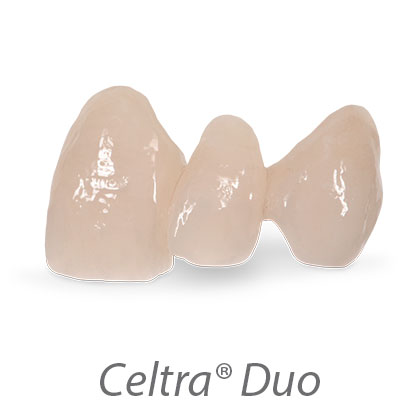
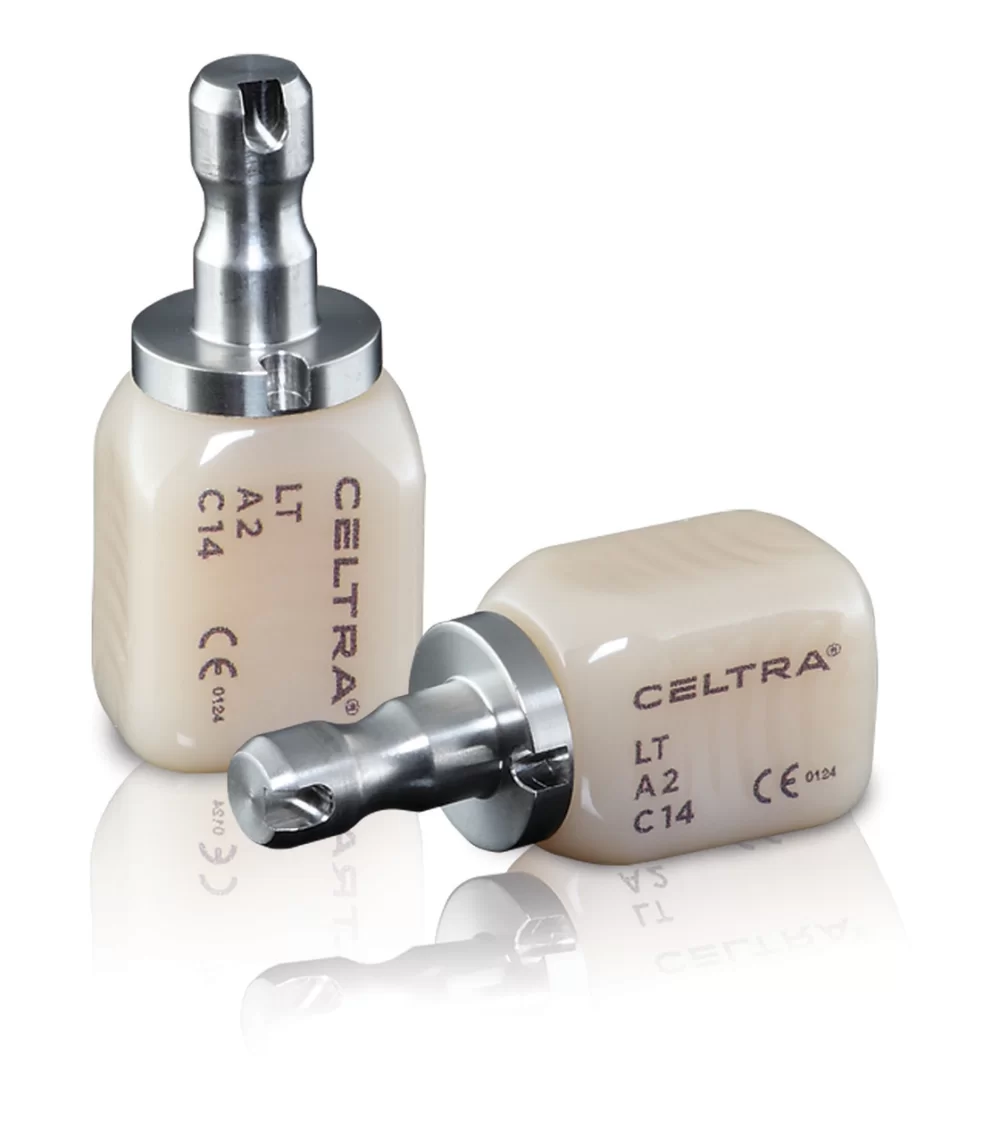
Celtra Duo is Dentsply Sirona’s CAD/CAM block in zirconia-reinforced lithium silicate (ZLS). The manufacturer’s brochure is written for the dental laboratory: the block is milled in its crystalline state and already in tooth shade, so the lab can finish it without a crystallisation firing. Your clinic sends the scan or impression; we design, mill and finish.
- 10% zirconia dissolved in the glass phase: per Dentsply Sirona, it is atomically dissolved, drives crystal nucleation and adds strength.
- Ultra-fine microstructure: Celtra’s lithium silicate crystallites measure 500–700 nm versus 2,000–4,000 nm in conventional lithium disilicate.
- High glass content: the manufacturer links this to opalescence, fluorescence, a chameleon effect and a reduced risk of greying.
Indications, translucency and shades
The brochure lists five indications: crowns, partial crowns, inlays, onlays and veneers. Bridges are not among them, so Celtra Duo is not used for bridgework.
- LT (12 shades): BL2, BL3, A1, A2, A3, A3.5, B1, B2, C1, C2, D2, D3.
- HT (8 shades): A1, A2, A3, B1, C1, C2, D2, D3.
Both are supplied as C14 blocks. There is no Celtra Duo block in BL1, A4, B3, B4, C3, C4 or D4. Shade can be fine-tuned with Dentsply Sirona Universal stains; for a shade outside the list, we will contact you before milling.
Two finishing pathways, two strength values
Strength depends on how the block is finished, so each figure needs its condition:
| Finishing | 3-point bending | Biaxial bending |
|---|
| Milled and polished only | 210 MPa | 413 MPa |
| Milled and fired at 820 °C | 370 MPa | 560 MPa |
The 3-point values are Dentsply Sirona in-house measurements; the biaxial values come from Justus-Liebig-Universität Gießen. Biaxial testing gives higher numbers, so do not compare across columns.
- Mill and polish: the fastest route. The processing guidelines warn that Celtra Duo turns shiny quickly, so it is easy to under-polish; the 210 MPa comes from proper smoothing and polishing, not from the gloss itself.
- Mill and fire: stain and glaze then fire, or polish then fire without glaze. Dentsply Sirona recommends firing where maximum strength is needed.
The brochure also cites an in-vitro study from the University of Heidelberg (Rues, Müller, Schmitter, 2012) on anterior crowns: after 6,000 thermal cycles (5–55 °C) and 1.2 million chewing cycles at 70 N, Celtra’s median fracture load was 725 N before and 766 N after ageing. This is laboratory data, not a clinical survival rate.
Preparation and minimum wall thickness
Minimum thicknesses per Dentsply Sirona’s processing guidelines:
- Posterior crowns: 1.5 mm occlusal (1.5–2 mm if the restoration is polished only), 1.5 mm axial, 1.0 mm at the cervical margin.
- Anterior crowns: 1.5 mm incisal, 1.5 mm axial, 1.0 mm cervical.
- Inlays: 1.5 mm.
- Onlays: 2.0 mm over cusps, 1.5 mm in the fissure.
- Veneers: 1.0–1.5 mm incisal, 0.6 mm labial, 0.4 mm cervical.
These minimums must still be met after any manual adjustment. If the scan shows too little space, we flag it before milling. For general preparation principles, see minimally invasive preparation for crowns and veneers.
Bonding and cementation
- Etch: clean the restoration, etch the intaglio with 5–9% hydrofluoric acid gel for 30 seconds, rinse and dry.
- Silane: silanate the etched surface straight away, leave it for 60 seconds and blow dry. Dentsply Sirona suggests Calibra Silane Coupling Agent.
- Fully adhesive cementation: highly recommended for crowns, inlays, onlays and veneers; the suggested cement is Calibra Ceram with Prime&Bond elect adhesive, the three-step system shown in the brochure.
- Self-adhesive cementation: Calibra Universal, recommended for crowns, inlays and onlays, but not for veneers.
Follow each product’s full instructions for use for the complete procedure.
Ordering Celtra Duo from Khai Nguyen
In-lab working time for Celtra Duo is 1.5–5 days, as shown at the top of this page. Overseas cases then ship by DHL Express, usually 2–4 days. The lab works Monday to Saturday, 08:00–19:00 (Vietnam time), and is ISO 13485 certified. More on timing in Vietnam dental lab turnaround time and shipping.
With the case, please state:
- The restoration type (crown, partial crown, inlay, onlay or veneer) and tooth numbers.
- LT or HT, the VITA shade, the stump shade if the preparation is discoloured, and shade photos if available.
- The finishing pathway: polished only, or fired for higher strength.
Restorations are covered by our general warranty (6 months to 15 years depending on the material). To compare, see IPS e.max CAD, the dental ceramic materials comparison and our onlay, inlay and overlay page. To discuss a case, please contact Khai Nguyen or follow our ordering process.
Technical values come from the Dentsply Sirona Celtra Duo brochure and the manufacturer’s Guidelines for processing Celtra Duo. This page is written for dentists and dental technicians. Khai Nguyen Dental Lab fabricates restorations only on professional prescription and does not sell directly to patients.