What IPS e.max Press is
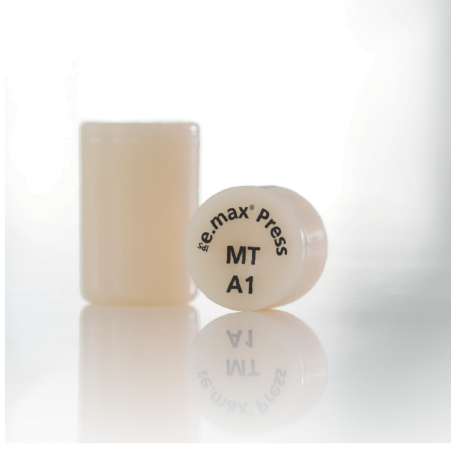
IPS e.max Press is Ivoclar Vivadent’s lithium disilicate glass-ceramic ingot for the press technique. The technician builds a wax pattern (or prints one from a CAD design), invests it, then heats the ingot and presses it into the mould. The restoration comes out tooth-coloured and is either stained and glazed with IPS Ivocolor, or cut back and layered with IPS e.max Ceram.
According to the manufacturer’s Instructions for Use, biaxial flexural strength averages 470 MPa (specification minimum 360 MPa), and the material is classified Type II / Class 3 under ISO 6872:2015. That is below zirconia but several times stronger than feldspathic porcelain, and more importantly, lithium disilicate can be etched with hydrofluoric acid and bonded, so thin restorations perform well when they are bonded correctly.
Indications and contraindications
Ivoclar lists IPS e.max Press for: occlusal veneers (table tops), thin veneers, conventional veneers, inlays, onlays, partial crowns, minimally invasive and conventional crowns in the anterior and posterior region, 3-unit anterior bridges, 3-unit bridges in the premolar region up to the second premolar as the terminal abutment, and implant superstructures for single teeth or 3-unit bridges within the same limit.
The manufacturer explicitly excludes: inlay-retained bridges, cantilever bridges and adhesive bridges; pontics wider than 11 mm in the anterior or 9 mm in the premolar region; very deep subgingival preparations; patients with a severely reduced residual dentition; and bruxism. Molar bridges are not indicated. For those cases zirconia is the safer choice; the thresholds are set out in our dental ceramic materials comparison.
Choosing the ingot translucency
IPS e.max Press offers the widest translucency range of the three press ceramics we use. Picking the right level matters more than picking the right brand:
- HT (high translucency, close to natural enamel): smaller restorations such as inlays, onlays and veneers on a natural-coloured preparation. The restoration borrows colour from the tooth beneath it.
- MT (medium translucency): when the case needs more brightness than HT but more translucency than LT.
- LT (low translucency, close to dentin): larger restorations such as posterior crowns; it holds brightness and chroma and keeps the seated restoration from greying.
- MO (medium opacity) and HO (high opacity): frameworks over slightly (MO) or severely (HO) discoloured preparations, finished by layering IPS e.max Ceram.
- Multi (polychromatic ingot with a built-in dentin-to-incisal gradient) and Impulse Opal (opalescent effect for veneers in light shades).
The single most useful thing to send with the case is the preparation (stump) shade next to the target shade. The IFU treats stump shade, restoration thickness and ingot translucency as three variables that decide the final colour together.
Minimum thickness and preparation
Ivoclar is explicit that predictable results depend on respecting minimum thicknesses. The key values:
- Thin veneers: at least 0.3 mm cervically and labially, 0.4 mm at the incisal edge.
- Stained monolithic crowns: anterior at least 1.2 mm circular and 1.5 mm incisal; posterior 1.5 mm circular and occlusal.
- Minimally invasive crowns: never below 1 mm, adhesively bonded only (no conventional or self-adhesive cementation), and canine guidance must be present.
- Margins: rounded shoulder or chamfer at least 1 mm wide, with no sharp edges.
If a case falls short of these values, we contact the practice before pressing rather than going thinner than the guidance. A restoration pressed below minimum thickness is the most reliable way to get a fracture a few years later.
Cementation
Depending on the indication, IPS e.max Press restorations can be bonded adhesively, cemented self-adhesively or cemented conventionally. For veneers (including thin and occlusal veneers), inlays, onlays, partial crowns and minimally invasive crowns, the manufacturer makes adhesive bonding mandatory: HF etching of the intaglio, silane, then a resin cement. Only conventional crowns and bridges may be cemented self-adhesively or conventionally, and then only on a retentive preparation.
Stained monolithic or cut-back and layered
In our lab, a stained and glazed monolithic crown takes 2.5 working days for 1–3 units and up to 4 days for more than 12 units; a cut-back case layered with IPS e.max Ceram at the incisal edge takes 3–5 working days, because the layering is done by hand. Shipping time comes on top of that; see turnaround and shipping. Monolithic staining is stronger and faster, and suits posterior teeth and cases with limited space. Cut-back and layering gives a more translucent incisal edge with more depth, and suits anterior teeth that must match natural neighbours.
We usually choose IPS e.max Press MT or HT for veneers and anterior crowns that must match natural teeth, because many dentists already work with this shade system and it is easy to cross-reference with e.max CAD. For a detailed comparison with the other two lines, see IPS e.max Press vs GC LiSi Press vs Shofu Vintage LD.
Cases from our lab
To discuss a specific case, contact our team or start through the ordering process.
Technical values are taken from Ivoclar Vivadent’s IPS e.max Press Instructions for Use (downloadable in the documents section below). Written for dentists and technicians. Khai Nguyen Dental Lab manufactures to clinical prescription only and does not sell directly to patients.