Where Cercon ht sits in the Cercon family
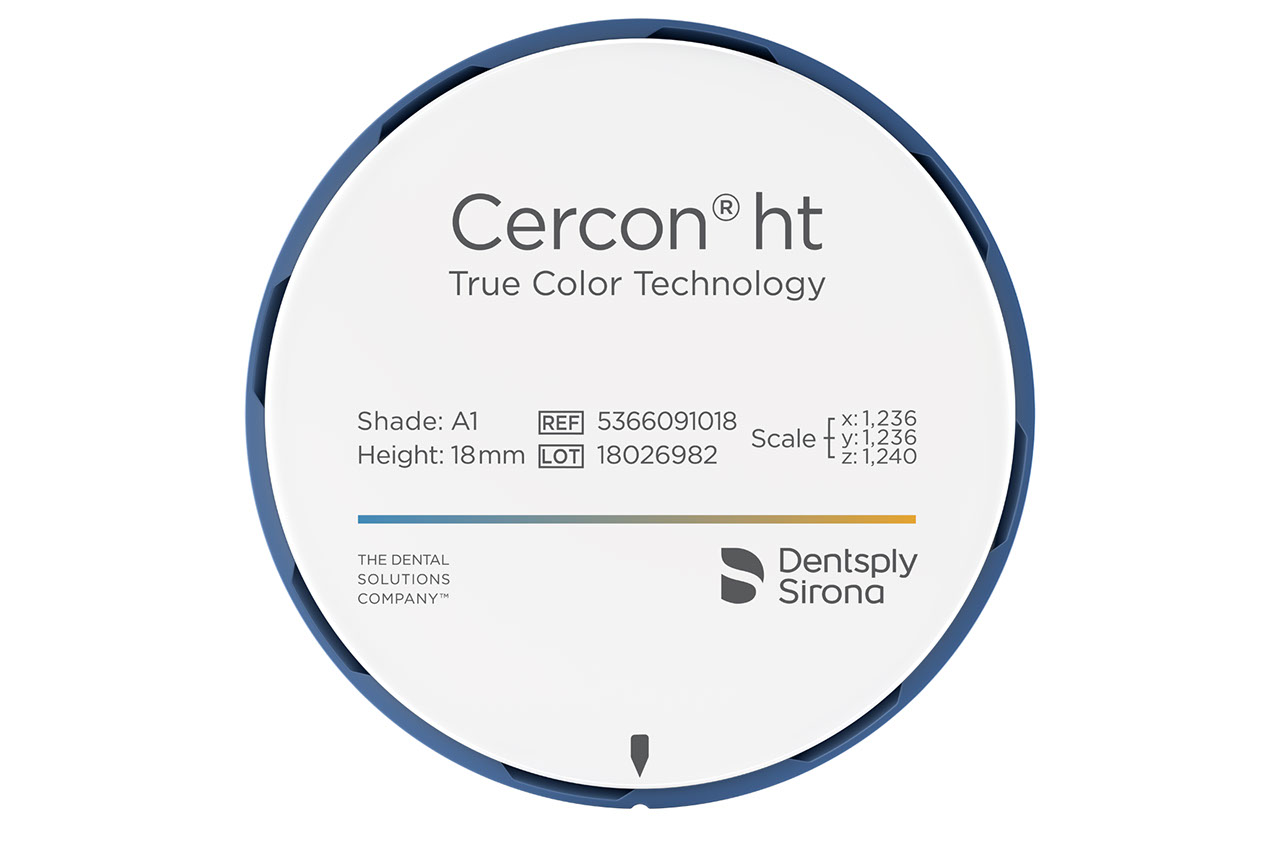
Cercon is Dentsply Sirona’s fine-grained Y-TZP zirconia line, with three variants: Cercon base (semi-opaque), Cercon ht (high translucency) and Cercon xt (extra translucency). Cercon ht came as a white blank in 2011, and pre-shaded discs in all 16 VITA shades plus bleach followed in 2015. The brochure lists 5% yttrium oxide by weight and a sintering temperature of 1,500 °C.
Khai Nguyen works only with single-layer Cercon ht, pre-shaded and white. We do not stock Cercon base, Cercon xt or the multilayer ht ML and xt ML discs; every value below refers to Cercon ht.
Pre-shaded or white blanks
The Cercon ht shade concept lets a lab reproduce the 16 VITA shades by milling a pre-shaded disc in the prescribed shade, or by milling a white disc and dipping it, with six base dipping shades covering all 16 VITA shades. The manufacturer describes five finishing levels: glazed, stained and glazed, cut-back, partially veneered and fully veneered. Tell us the level you want on the prescription and we choose the blank and workflow accordingly.
Indications and limits
- Monolithic: posterior crowns; anterior or posterior bridges with up to two adjacent pontics; posterior cantilever bridges with a cantilever no wider than one premolar.
- Anterior single crowns: the manufacturer’s monolithic indications list posterior crowns only, so anterior Cercon ht crowns are made fully or partially veneered. With tight space, a facial-only veneer lets the palatal zirconia stay at its 0.5 mm minimum.
- Implants: crowns, bridges and two-piece abutments (a zirconia part bonded to a titanium base). Multi-unit implant bridges should be monolithic; veneered implant superstructures are best limited to three-unit bridges because of the chipping risk.
- Not approved by the manufacturer: inlay bridges, custom posts and custom endosseous implants.
Stump shade matters. Cercon ht is meant for slight to moderate discoloration; the manufacturer recommends the more opaque Cercon base, which we do not stock, for heavy discoloration or metal posts, so please flag such cases first.
Preparation guidelines
Use a chamfer or a shoulder with a rounded internal angle; feather-edge margins are not recommended. Keep a 6–8° taper, rounded line angles and a simplified occlusal relief. For monolithic Cercon ht the manufacturer asks for 0.5–0.7 mm occlusal reduction and at least 0.5 mm at the margin, close to a full cast crown. Fully veneered restorations need 1.0 mm circular and 2.0 mm incisal reduction in the anterior region, and at least 1.5 mm occlusal reduction in the posterior region. Besides the three-unit connector sizes in the specification tab, four-unit anterior bridges need at least 9 mm², and four-unit frameworks should be thickened to 0.6–0.7 mm occlusally and on the pontic side.
Adjustment and cementation
- Adjust before cementing with zirconia-specific diamonds, then polish in several steps extraorally. Low antagonist wear depends on a properly polished surface.
- Temporary cementation is possible with Cercon ht, but for 2–3 weeks at most and preferably with a translucent temporary cement.
- Conventional cementation works with at least 4 mm of preparation height and a 3–5° taper; resin-modified glass ionomer is preferred over zinc phosphate or plain glass ionomer, and those two should not be used where retention loss is a risk, such as mandibular posterior bridges.
- Adhesive cementation suits short or very tapered preparations and longer bridges: self-adhesive resin cement, or resin cement with a phosphate monomer or zirconia primer, after sandblasting with 50 µm alumina at 1–2 bar. Choose translucent cements rather than opaque ones.
- On implants, custom abutments place the cement line at or just below the gingiva for easier cleanup; conventional or self-adhesive cements are preferred over dual-curing resin cements.
Ordering Cercon ht from overseas
Send an intraoral scan or an impression; we design, mill, sinter and finish. Zirconia crowns and bridges take 2–4 working days in the lab, and zirconia on implants 3–4.5 working days depending on the number of units. DHL Express then delivers in 2–4 days. Details are on our turnaround and shipping page. With each case, please include:
- The VITA shade and the finishing level (glazed, stained, cut-back or veneered).
- The stump shade, with a photo of the preparation next to a shade tab. The manufacturer stresses this for high-translucency zirconia.
- Available space and any bruxism, since veneered restorations are contraindicated in both situations.
For implant work, see implant bridges and crowns and our single zirconia crown on a CAD/CAM titanium abutment. Compare Cercon ht with other blanks in the dental ceramic materials comparison. To discuss a case, contact Khai Nguyen or follow our ordering process.
Technical values come from Dentsply Sirona’s Cercon Clinical Manual (2019) and Cercon family brochure, listed in the sources below. This page is written for dentists and dental technicians. Khai Nguyen Dental Lab fabricates restorations only on professional prescription and does not sell directly to patients.