What GC Initial LiSi Press is
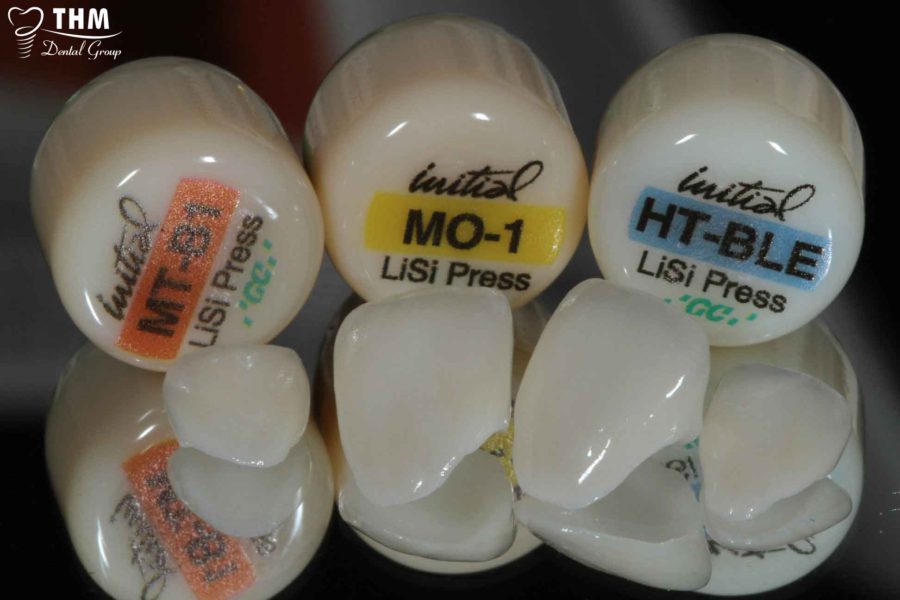
GC Initial LiSi Press is GC’s (Japan) pressable lithium disilicate ingot, part of the GC Initial system many technicians already know from its layering porcelains. What sets it apart from conventional lithium disilicate ingots is HDM (High Density Micronization): instead of larger crystals, evenly dispersed lithium disilicate micro-crystals fill the entire glass matrix.
In GC’s published data (internal testing following ISO 6872:2015), biaxial flexural strength reaches 508 MPa, against 442 MPa for a conventional lithium disilicate press ceramic in the same test. Chemical solubility is about one fifth (5.4 vs 24.2 µg/cm²). GC links the fine structure to two benefits that matter more in practice than the strength figure: a surface that polishes quickly after chairside occlusal adjustment, and low wear on the opposing teeth.
Four translucency levels
LiSi Press comes in four ingot groups, chosen by restoration thickness and stump shade rather than by target shade alone:
- HT (high translucency): enamel replacement, for veneers and inlays/onlays on a natural-coloured preparation. Includes bleach shades (EXW, BLE) and enamel shades E57–E60.
- MT (medium translucency): the widest shade range (B00 to D2), used for most veneers, crowns and bridges.
- LT (low translucency): four groups A, B, C and D, for crowns and bridges that need stable brightness.
- MO (medium opacity): MO-0, MO-1 and MO-2, to mask discoloured preparations. In GC’s brochure, MO is shown masking heavy tetracycline discoloration.
LiSi keeps its colour through multiple firings, so if the first try-in calls for a shade correction, the lab can stain and fire again without shifting the restoration’s base colour.
Indications
GC presents LiSi Press for ultra-thin veneers, inlays, onlays and overlays, single crowns in the anterior and posterior region, small bridges and implant restorations. GC’s brochure only says “small bridges”; we make LiSi Press bridges of up to 3 units, up to the second premolar, in line with the IPS e.max Press limit. Molar bridges, and patients with heavy bruxism who do not wear a night guard, should move to zirconia; see our dental ceramic materials comparison.
Cementation
GC’s luting protocol:
- Veneers: adhesive bonding only, with a dual-cure resin cement (GC recommends G-CEM LinkForce, which has try-in pastes to check the cement shade before bonding).
- Inlays and onlays: adhesive bonding; a self-adhesive resin cement or resin-modified glass ionomer only on retentive preparations.
- Crowns and bridges: adhesive bonding, self-adhesive resin cement or resin-modified glass ionomer, at the dentist’s discretion.
For high-esthetic cases, the cement try-in step is worth more than any difference between ceramic brands, because on a thin veneer the cement shade is part of the final colour.
When we choose LiSi Press
We usually choose LiSi Press for monolithic premolar crowns and for inlays/onlays, where fast polishing and marginal fit count most. It also suits multi-unit veneer cases that need even translucency across the arch.
In the lab, a stained and glazed monolithic crown takes 2.5 working days for 1–3 units and up to 4 days for more than 12 units. A cut-back case layered with GC Initial LiSi porcelain at the incisal edge takes 3–5 working days. Shipping comes on top; see turnaround and shipping.
If you already work in another brand’s shade system, we recommend staying with it. Consistency between the chairside shade guide and the lab’s ingot matters more than the technical differences between the three lines. The full comparison is in IPS e.max Press vs GC LiSi Press vs Shofu Vintage LD.
Cases from our lab
To discuss a specific case, contact our team or start through the ordering process.
Technical values are taken from GC’s GC Initial LiSi Press brochure (downloadable in the documents section below); the strength and solubility comparisons are GC’s internal data. Written for dentists and technicians. Khai Nguyen Dental Lab manufactures to clinical prescription only and does not sell directly to patients.