What bonding on a Ti-base solves
Both classic options for implant restorations have drawbacks. Direct screw retention is retrievable and cement-free, but the access hole may show facially and weakens the ceramic where it takes load. Cementing in the mouth puts the restoration in the ideal esthetic position, but excess cement below the tissue is hard to detect and remove, and it is a well-documented cause of peri-implantitis.
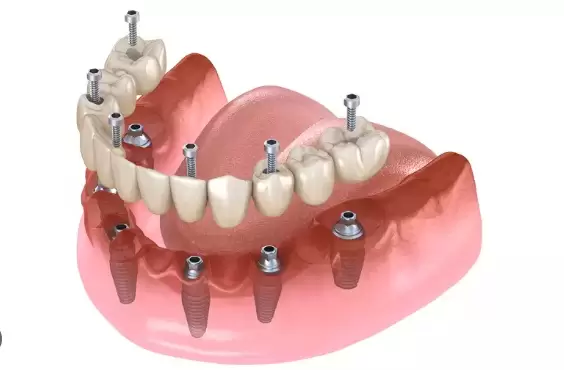
A restoration bonded to a Ti-base (a hybrid restoration) combines the advantages: the zirconia crown or abutment is bonded to the titanium base extraorally, in the lab, under controlled conditions, and the whole unit is then screwed onto the implant.
The result: no cement below the tissue, still retrievable, and the access hole can be redirected with an angled base or angled screw channel so it does not show facially.
Two common designs
- A monolithic zirconia crown bonded directly to the Ti-base, screw-retained: compact and simple, well suited to posterior teeth.
- A hybrid abutment (a custom zirconia body bonded to a Ti-base) with a separate crown: we can shape the transmucosal part freely around the existing profile, and it is tooth-coloured instead of grey under thin anterior tissue.
The connection to the implant is always the titanium of the Ti-base. Zirconia in direct contact with the implant’s titanium connection causes micro-wear, so a one-piece zirconia abutment should only be considered when the implant manufacturer certifies that configuration.
Extraoral bonding in our lab
- Titanium base: low-pressure alumina air-abrasion, cleaning, then a primer containing phosphate monomer. Skipping the abrasion step clearly reduces bond strength.
- Zirconia: cannot be acid-etched; it is mechanically roughened and primed with a phosphate-monomer primer. A lithium disilicate crown is HF-etched and silanated instead.
- Cement: resin cement in the right amount, excess removed at the gel stage; after curing, the whole ceramic–titanium junction is polished, especially the subgingival part.
- Emergence profile: slightly concave next to the implant shoulder, flaring only near the gingival margin; the entire subgingival surface smooth and polished.
Details and references are in hybrid abutment crowns on a titanium base.
When intraoral cementation still makes sense
- Multi-unit bridges on non-parallel implants, when a screw-retained unit has no common path of insertion.
- When the axis correction needed exceeds what available angled bases allow.
- When the margin sits at or above the gingiva, so excess cement can be controlled visually.
What to send us
- The exact implant system and Ti-base code: manufacturer, line, connection diameter.
- An intraoral scan with the correct scan body, the opposing arch and a bite scan.
- A photo of the emergence profile right after removing the healing abutment; for the esthetic zone, a scan of the provisional that shaped the tissue and the tissue compression you want (for example 0.3, 0.5 or 0.8 mm).
- The preferred screw-access direction in the esthetic zone; shade, shade photos and a note on bruxism.
Turnaround and warranty
Crowns and bridges on Ti-bases take 3 working days in the lab for 1–3 units and up to 4.5 days for more than 12 units, from file approval. Shipping comes on top; see turnaround and shipping. Covered by our general warranty (6 months to 15 years depending on the material).
Cases from our lab
Other implant options are on implant bridges and crowns. To discuss a specific case, contact our team or start through the ordering process.
Written for dentists and technicians. Khai Nguyen Dental Lab manufactures to clinical prescription only and does not sell directly to patients.