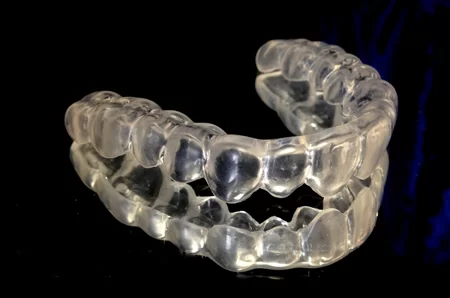

Jaw Stabilization Splint
A hard full-arch splint in medical-grade resin meeting FDA standards, giving even contact with the opposing teeth: it protects teeth and restorations in bruxers and supports TMD treatment on the dentist’s prescription.



A hard full-arch splint in medical-grade resin meeting FDA standards, giving even contact with the opposing teeth: it protects teeth and restorations in bruxers and supports TMD treatment on the dentist’s prescription.
A jaw stabilization splint (occlusal or bite splint) is a hard full-arch appliance that gives even contact with the opposing teeth, so the masticatory muscles can relax and the TMJ is unloaded. Material: medical-grade resin meeting FDA standards, custom-made on each patient’s models.
The splint is not an orthodontic retainer and does not advance the mandible. For protection during sport, see the custom sports mouthguard. For snoring or sleep apnea, see the sleep apnea appliance.
For labs or clinics that print splints in-house, we design the bite splint and send the file back: 12 hours for the design, with a 2-hour express option. Other design items are listed on our dental CAD design service page.
Check fit and contacts intraorally, adjust lightly if needed, and schedule a review of the bite and symptoms. In heavy bruxers the splint wears over time; check it regularly and remake it when it is thin or cracked.
To discuss a specific case, contact Khai Nguyen.
Written for dentists and technicians. Khai Nguyen Dental Lab manufactures to clinical prescription only and does not sell directly to patients.
Our stabilization splint is hard resin. Our custom sports mouthguard (multi-layer, 2–6 mm) absorbs impact in sport and is not a substitute for a stabilization splint in a bruxer.
A systematic review by Boulatar et al. (Dental and Medical Problems 2026) describes the stabilization splint as rigid acrylic with a flat, smooth occlusal surface. Opposing teeth contact it evenly and simultaneously in centric relation, contacts in maximum intercuspation are simultaneous and symmetrical, and canine guidance is maintained in lateral movements.
| Element | Principle in the literature | What to write on the Rx |
|---|---|---|
| Coverage | Full arch, so load spreads over all teeth | Upper or lower arch |
| Occlusal surface | Flat, smooth, even simultaneous contacts in centric relation | Bite registration position, posterior opening |
| Excursions | Canine guidance in lateral movements | Canine guidance or another scheme |
| Thickness | Too thick can impede swallowing, lip seal or speech | Desired vertical opening (mm) |
Albagieh et al. add that a splint which does not cover all teeth or contact the opposing teeth evenly should not be worn for four to six weeks, and that wearing a splint 24 hours a day may cause irreversible occlusal changes.
The splint is a reversible protective measure, not a cure. Diagnosis and assessment of outcome rest with the dentist; we are responsible for fit, contacts and guidance as prescribed.
International cases ship by DHL Express, typically 2–4 days; see turnaround and shipping.
Sources: Okeson JP, J Am Dent Assoc 1987;114(6):788–91; Albagieh H et al., Saudi Dent J 2023;35(1):70–79; Boulatar Y et al., Dent Med Probl 2026;63(2):509–516; Riley P et al., Br Dent J 2020;228(3):191–197; Macedo CR et al., Cochrane Database Syst Rev 2007, CD005514.
Please leave your information with us. We will respond to you as soon as possible.