

Case fabricated at Khai Nguyen Dental Lab to the treating dentist’s prescription. Photos were taken by the lab on the model and published on Instagram @khainguyendentallab on 12 January 2026 and on Facebook on 16 June 2026. No patient-identifying information is included. Written for dentists and dental technicians.
Case summary
| Indication | Indirect posterior restorations: ceramic inlays, onlays and overlays |
|---|---|
| Material | IPS e.max Press or IPS e.max CAD, chosen by cavity form and esthetic demand |
| Technical priorities | Marginal fit, occlusal anatomy continuous with the remaining tooth, seamless transition zone |
| Typical in-lab time | 2 to 3 working days |
| Photo sources | Instagram, 12 January 2026 and Facebook, 16 June 2026 |
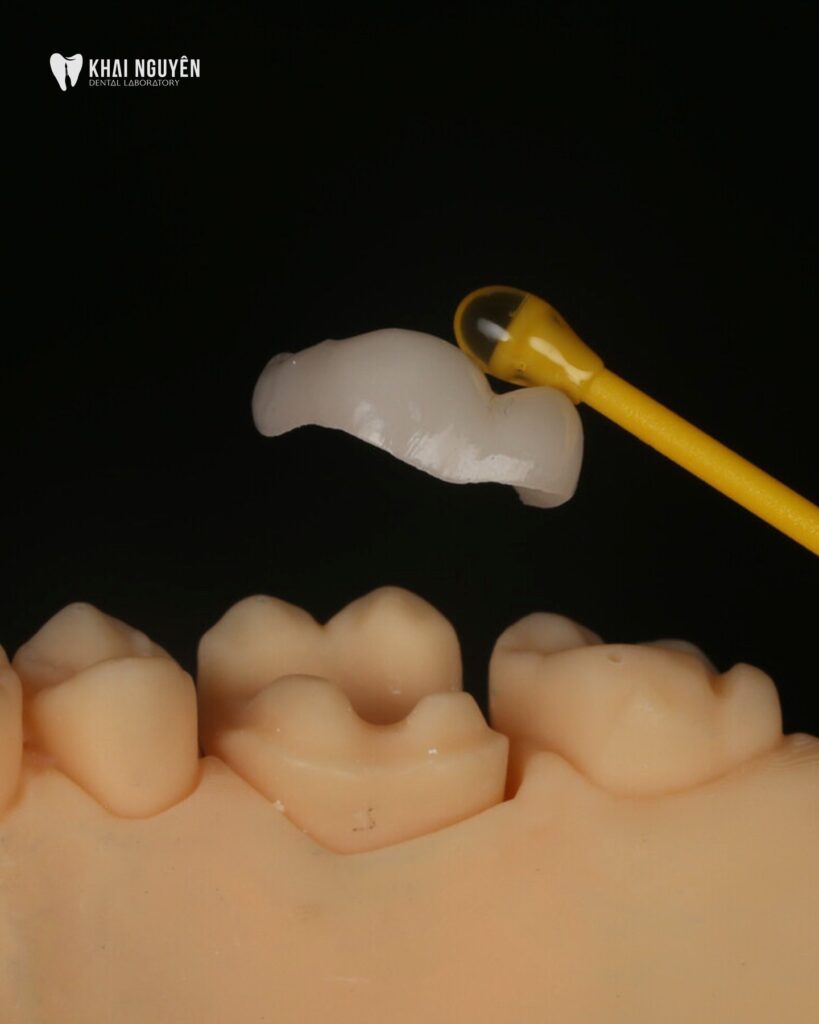
Photo above: a ceramic overlay seated on the model, with the margin closing against the adjacent teeth.
Why a small case is a hard case
Inlays and onlays are often treated as simple work: one unit, no anterior esthetics. At the bench the opposite is true. The smaller the restoration, the less error it tolerates.
A posterior crown that is 50 microns short at the margin can still be compensated by cement, and a subgingival finish line hides much of it. An inlay that is 50 microns short leaves that gap on the occlusal surface, where the patient feels it with the tongue and where plaque collects.
Three requirements the lab has to meet at once:
- Marginal fit. An inlay preparation has several walls and angles; the restoration must seat along one path without binding, and close everywhere along its perimeter.
- Anatomy continuous with the remaining tooth. Unlike a crown, an inlay or onlay replaces only part of the tooth, so cusps, grooves and marginal ridges have to run without a break into the remaining natural enamel.
- A seamless transition zone. This is the criterion Khai Nguyen treats as the most important for this group: the boundary between ceramic and enamel should be invisible in colour, in gloss and in surface form.
e.max Press or e.max CAD
Both are lithium disilicate with comparable flexural strength, and both bond with the same etch-and-silane protocol. They differ in how the shape is produced:
- e.max Press goes through a wax stage, so the technician builds cusps, grooves and proximal contacts by hand on the model. That helps with complex cavities, thin walls, or when occlusal contacts need fine adjustment. After pressing, the unit can be cut back and layered when the case needs depth of colour.
- e.max CAD is milled from a block: fast and consistent, suited to clearly defined cavities and to shorter turnaround. In exchange, secondary grooves and proximal contacts are refined after milling.
The lab chooses by cavity form rather than by default. Our ceramic materials comparison lists strength and minimum thickness for each family.
Lab workflow
- Assess the preparation before designing. Path of insertion, wall taper and margin quality are read first. If there is an undercut or a wall is too thin, the lab reports back before production instead of compensating with a thicker restoration.
- Design to the remaining tooth. Cusps and grooves are built to run into the natural enamel; no default tooth library is used at the junction.
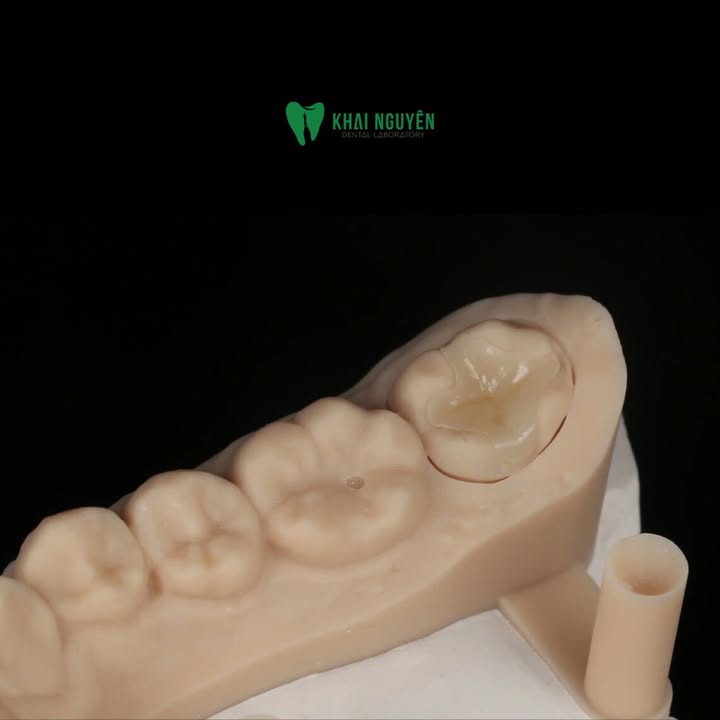
- Press or mill, then try on the model to confirm a single path of insertion and a closed margin.
- Contacts and occlusion. Proximal contacts are adjusted against the neighbouring teeth, and static and excursive occlusion are checked on the articulator.
- Surface finishing. Occlusal texture is created, then the unit is polished mechanically, with thick glaze avoided on contact areas so the opposing tooth is not abraded. See glazing vs polishing.
Feedback from the clinic
In September 2025 Dr Nguyen Thanh Dung noted the naturalness and continuity of the transition zone in the inlay and onlay cases produced by the lab. That is the criterion the lab pursues for this group of restorations, because it is what the patient feels with the tongue every day and where discolouration appears first over time.
Lessons for inlay and onlay cases
- Prepare a clear path of insertion. An undercut forces the lab to compensate with a thick cement layer, which reduces fit and increases the risk of debonding.
- State the material you want and why. Choose e.max CAD for speed, e.max Press for complex cavities or when layering is needed.
- A clear impression and an early shade photo. A clear finish line, a cavity without unnecessary sharp internal angles, and a shade photograph taken before the tooth dehydrates all help the lab considerably. If the cavity is too shallow in a load-bearing area, raise it with the lab before production rather than at try-in.
- Send the opposing scan and a bite record. Inlays and onlays sit on the occlusal surface, so occlusion decides their lifespan; without the opposing arch the lab can only guess the contacts.
- Re-polish after chairside adjustment. An adjusted area left unpolished is rough, stains and wears the opposing tooth.
See the inlay, onlay and overlay product page or send a case via WhatsApp +84 902 945 585.
Written for dentists and technicians. Khai Nguyen Dental Lab manufactures to clinical prescription only and does not sell directly to patients.