


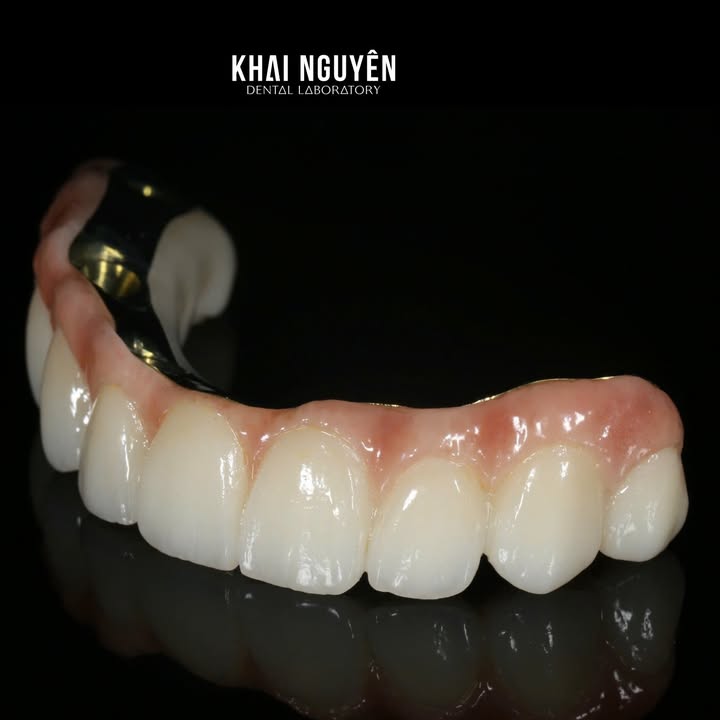
Summary: the hybrid abutment crown combines the advantages of screw retention and of adhesive bonding: the ceramic crown is bonded to a titanium base extraorally, and the assembly is then screwed onto the implant. This article covers why that solves the weaknesses of both original options, what the extraoral bonding protocol requires, and when intraoral cementation is still the right choice.
The problem with each original option
Direct screw retention
Its greatest advantage is retrievability: for repair, for cleaning, for implant complications. With no cement there is no risk of residual cement subgingivally. The drawback is that the screw channel sits on the occlusal or facial surface, taking up space and compromising aesthetics anteriorly, while also weakening an all-ceramic restoration precisely where it carries load.
Intraoral cementation
It allows the restoration to be positioned aesthetically regardless of implant axis, with no screw channel. Its serious drawback is excess subgingival cement: hard to detect, hard to remove completely, and a well-documented contributor to peri-implantitis. The deeper the margin, the less controllable the residue.
How the hybrid abutment crown resolves this
The ceramic crown is bonded to the titanium base extraorally, in the laboratory, under controlled conditions: clean surfaces, a correct surface-treatment protocol, a measured quantity of cement, and complete removal of excess followed by polishing before the case leaves the lab. The assembly is then screwed onto the implant like any screw-retained restoration.
The result: no subgingival cement, full retrievability, and a screw channel that can be redirected using an angled base or an angulated screw so it does not emerge facially.
The extraoral bonding protocol
Titanium surface
The titanium base is air-abraded with aluminium oxide at low pressure, cleaned, then treated with a phosphate-monomer primer. Skipping air abrasion reduces bond strength markedly and the restoration may debond from the base within months.
Ceramic surface
This differs by material. Lithium disilicate is etched with hydrofluoric acid and silanated. Zirconia cannot be acid-etched — it requires mechanical roughening and a phosphate-monomer primer. Applying the wrong protocol to the wrong material compromises the bond from the outset.
Cement control
Use a dual-cure or chemically cured resin cement, in adequate but not excessive quantity, and remove excess at the gel stage. Once polymerised, the entire ceramic–titanium junction must be polished, especially the portion that will sit subgingivally.
The evidence base: strength and surface protocol
The surface protocol above is not house convention — it is the protocol used in the in vitro literature: titanium bases air-abraded with 50 µm Al₂O₃; zirconia abutments and crowns sandblasted; lithium disilicate etched with 9% hydrofluoric acid and silanated; bonded with a dual-cure resin cement.
On strength, an in vitro study of nine abutment and crown material combinations in the premolar region reported the highest fracture strength for the zirconia abutment–zirconia crown combination (about 1,417 N), followed by lithium disilicate abutment–zirconia crown (about 1,349 N). Retention studies on titanium bases report higher values for adhesive and self-adhesive resin cements than for conventional cements, and emphasise the role of surface pretreatment and MDP-containing primer systems.
On fit, an in vitro study examines internal fit and marginal adaptation of hybrid abutment crowns with custom-milled screw channels on titanium bases.
Emergence profile — what determines soft tissue
An implant is narrower than the tooth being replaced, so the contour from the implant shoulder up to the gingival margin always has to widen. Get that segment wrong and the soft tissue will not stabilise, whatever the material quality.
A practical principle: keep the portion adjacent to the implant shoulder slightly concave to leave room for tissue, and widen only as the gingival margin approaches. The entire subgingival surface must be smooth and polished.
When intraoral cementation is still appropriate
- Multi-unit implant bridges on non-parallel implants, where a screw-retained assembly has no common path of insertion.
- Cases requiring more axis correction than the available angled bases allow.
- Where the restoration margin is equigingival or supragingival, so excess cement is visually controllable.
The common condition for all three: the margin is not deeply subgingival. That is the practical boundary between “cementable” and “should not be”.
What the laboratory needs
- The exact implant system and base reference — manufacturer, line, platform diameter.
- A matching scan body or impression coping, securely seated and recorded.
- A photograph of the emergence profile immediately after removing the healing abutment, within the first seconds before the tissue collapses.
- A note on the preferred screw-channel direction in the aesthetic zone.
- Opposing model and bite registration.
FAQ
Is it as durable as direct screw retention?
The ceramic–titanium bond is durable when the surface protocol is followed. The practical weak point is not bond strength but omitted surface treatment or the wrong primer for the material.
Can it be retrieved and remade?
The whole assembly is retrievable via the screw. Separating the crown from the base usually sacrifices the ceramic.
Zirconia or lithium disilicate?
It depends on site and load. Zirconia posteriorly and for bridges; lithium disilicate for single aesthetic units because of its translucency. The materials comparison sets out strength and minimum thickness by group.
Does an angled base weaken the restoration?
Not if ceramic thickness around the screw channel still meets threshold. Problems arise when the axis deviates enough that the channel encroaches on a functional cusp — at which point implant position, or a different approach, should be reconsidered.
References
- Fracture Strength of Implant-Supported Hybrid Abutment Crowns: An In Vitro Study of Ceramic and Polymer-Based Materials in the Premolar Region. J Clin Med, PMC12693155.
- Fracture resistance of implant-supported monolithic crowns cemented to zirconia hybrid-abutments: zirconia-based crowns vs. lithium disilicate crowns. PMC5829289.
- Internal fit and marginal adaptation of all-ceramic implant-supported hybrid abutment crowns with custom-milled screw-channels on titanium-base: in-vitro study. PMC11391652.
- The Effect of Zirconia Material and the Height of the Ceramic Coping on the Strength of Hybrid Ti-Ceramic Abutments. PMC12293803.
- Tensile Retention of Lithium Disilicate and Zirconia Crowns Cemented to One-Piece Zirconia Implants. PMC13514237.
Bài viết dành cho bác sĩ và kỹ thuật viên tham khảo. Khai Nguyên Dental Lab chỉ chế tác phục hình theo chỉ định chuyên môn và không bán trực tiếp cho bệnh nhân.