


Case fabricated at Khai Nguyen Dental Lab to the treating dentist’s prescription, published on Instagram @khainguyendentallab on 11 June 2025. No patient-identifying information is included.
Case summary
| Indication | Ten pressed ceramic veneers, teeth 14 to 24 |
|---|---|
| Material | GC Initial LiSi Press |
| Shade | BL2 |
| Dentist | A long-standing international partner of the lab (name not published) |
| Photo source | Instagram @khainguyendentallab, 11 June 2025 |
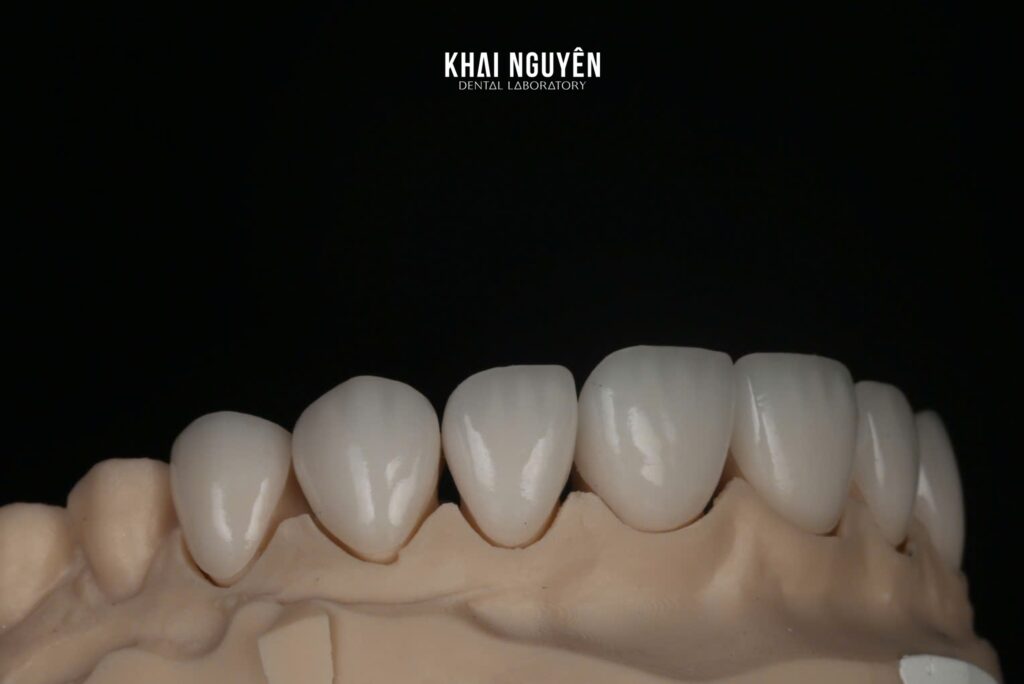
Photo above: ten LiSi Press veneers in shade BL2 on the model, frontal view.
What the dentist asked for
The prescription was a smile arch from tooth 14 to 24 in bleach shade BL2 with natural incisal effects. This was an overseas case, so the lab had no chance to adjust shade chairside: every decision about translucency, form and surface texture had to be right first time. All communication was by photograph and written description.
Why LiSi Press for ten bright units
At BL2 the consistency between units matters more than elaborate effects on any single tooth: the eye immediately spots one unit off-tone in a row of ten.
GC Initial LiSi Press has fine, evenly distributed lithium disilicate crystals, so translucency stays stable between pressings and across different thicknesses, which suits pressing many units at once. Compare the pressed systems in e.max Press vs LiSi Press vs Vintage LD Press.
For effects the case took a minimal approach: keep natural translucency in the incisal third, add light enamel striations, avoid pronounced dentin lobes. With bleach shades, strong effects make teeth look drawn rather than real.
Lab workflow
- Design all ten units in one file to unify incisal edge length, smile line and width proportions before pressing.
- Press in groups so units from the same pressing share thermal conditions, reducing shade differences between teeth.
- Light cut-back at the incisal third and translucent layering, keeping thickness minimal because bright-shade veneers need no thick masking layer.
- Selective mechanical polishing for a uniform micro-texture across the arch.
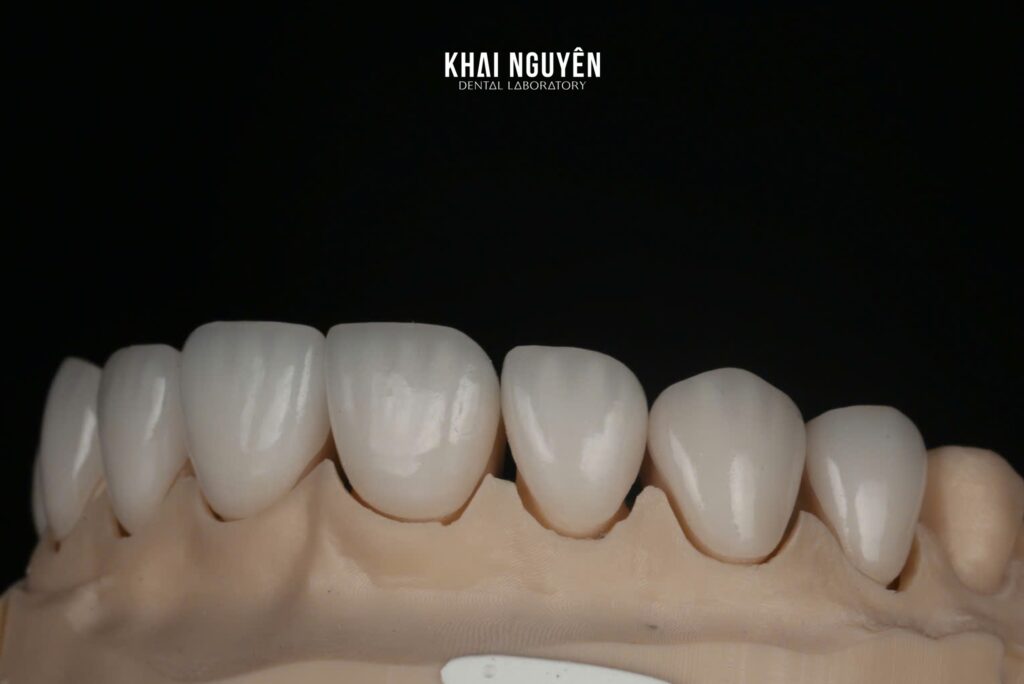
- Photograph from several angles before shipping, since a remote dentist needs to review before booking the seating appointment.
Four stages that decide the result
Behind these ten veneers is a sequence of four stages, and none of them rescues a mistake from the one before:
- Adjusting the coping for fit. Before shade enters the conversation, the restoration has to seat correctly on the preparation. This is settled at the framework stage, because any discrepancy left afterwards gets covered by ceramic and can no longer be corrected.
- Hand layering. LiSi Press provides a good translucent base, but the shade transition and the liveliness of the incisal edge still have to be placed layer by layer by the technician.
- Shaping the form. Form decides whether a veneer looks natural more than shade does. Length, outline, facial convexity and contact point position all have to suit the patient’s face and smile line.
- Creating surface texture. Natural teeth are not flat. Fine horizontal ripples and vertical grooves scatter light instead of reflecting it as one bright patch. Skip this and the veneer will be evenly coloured yet still read as artificial.
A coping that does not seat makes good shade irrelevant; wrong form cannot be saved by texture. That is why the lab checks at each stage rather than only inspecting the finished unit.
Lessons for multi-unit veneer cases sent from abroad
- Agree incisal edge length by measurement or a wax-up photo before the lab presses, because changing length afterwards costs the whole pressing.
- With bleach shades, ask for moderate effects. Write “light striations, translucent edge” rather than a generic “natural effects”. Read more on bleach shades and stain technique.
- Request multi-angle photos before dispatch on international cases; it is the only inspection before the restorations reach the patient. On a high-esthetic case, also ask for photographs at the framework stage or before glazing: a few minutes reviewing an image then is far cheaper than one remake.
Send a multi-unit veneer case via WhatsApp +84 902 945 585 or read the ordering process.
Written for dentists and technicians. Khai Nguyen Dental Lab manufactures to clinical prescription only and does not sell directly to patients.