


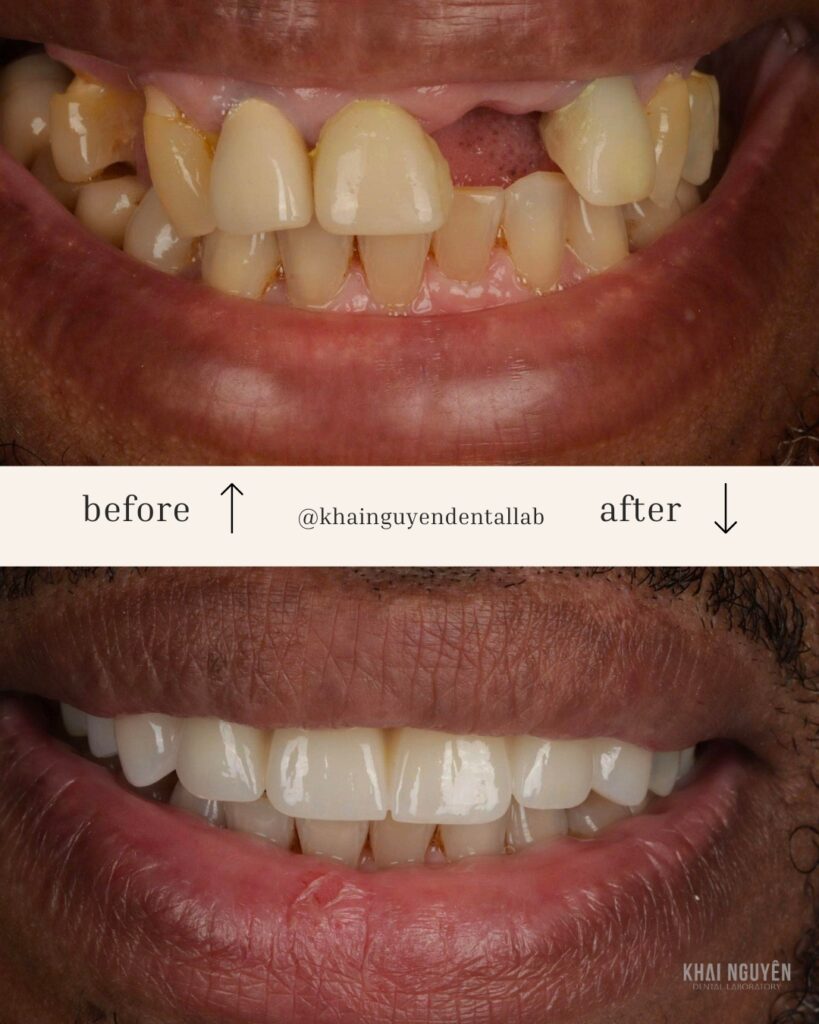
Case fabricated at Khai Nguyen Dental Lab to the treating dentist’s prescription, published on Instagram @khainguyendentallab on 18 August 2025. The before-and-after photos were sent to the lab by the dentist as feedback. No patient-identifying information is included.
Case summary
| Condition | Bruxism with V-shaped cervical wear |
|---|---|
| Indication | Full zirconia restoration of the arch |
| Dentist’s requirements | Squared form, translucent incisal edges, natural surface texture |
| Patient | International case |
| Photo source | Instagram @khainguyendentallab, 18 August 2025 |
Photo above: before treatment (top) and after seating the full zirconia restoration (bottom).
Why zirconia for a bruxing patient
For a patient who grinds, strength comes first. Pressed lithium disilicate has a flexural strength around 400 to 500 MPa, enough for single units in an average patient but risky against repeated parafunctional load. Zirconia, depending on the disc, reaches 800 to 1,300 MPa and tolerates that load far better (see the materials comparison).
The objection to zirconia is that it looks opaque and artificial. The dentist’s requirements here, squared form, translucent incisal edges and natural texture, are exactly what stops zirconia reading as a white block. The lab used a multilayer disc for a built-in gradient, created the surface texture by hand and preserved translucency in the incisal third instead of thickening uniformly.
V-shaped cervical wear and what it means for the design
V-shaped lesions at the cervical margin indicate repeated flexural load, usually alongside bruxism. For the lab this tells two things: the patient generates high forces so a strong material is needed, and the finish line sits close to already damaged tissue, so the margin must be designed carefully to avoid creating a new weak point.
The design also has to avoid premature contacts in excursion, since these are the source of the flexural load.
Lab workflow
- Occlusal analysis from the bite record and the opposing scan, identifying the main load-bearing areas.
- Squared form as requested with defined line angles, while load-bearing ridges are slightly rounded to distribute force.
- Multilayer disc selection, strong enough cervically and more translucent at the incisal edge.
- Hand-made surface texture after sintering, then thorough mechanical polishing instead of a thick glaze, because polished zirconia abrades opposing teeth less (see glazing vs polishing).
- Excursive contacts checked on the articulator and the case photographed before shipping.
Lessons for bruxing patients
- Tell the lab the patient grinds. It changes disc selection, minimum thickness and the finishing method.
- Consider a night guard alongside the restoration; the lab can make it from the same scan set (see occlusal splints).
- Prefer polishing over thick glaze on occlusal surfaces, to reduce wear of the opposing teeth once glaze wears away.
Send a case for a bruxing patient via WhatsApp +84 902 945 585, or read how we handle international cases.
Another multi-unit zirconia case: twelve units of ZirCAD Prime crowns and bridges, A3–A3.5.
Written for dentists and technicians. Khai Nguyen Dental Lab manufactures to clinical prescription only and does not sell directly to patients.