

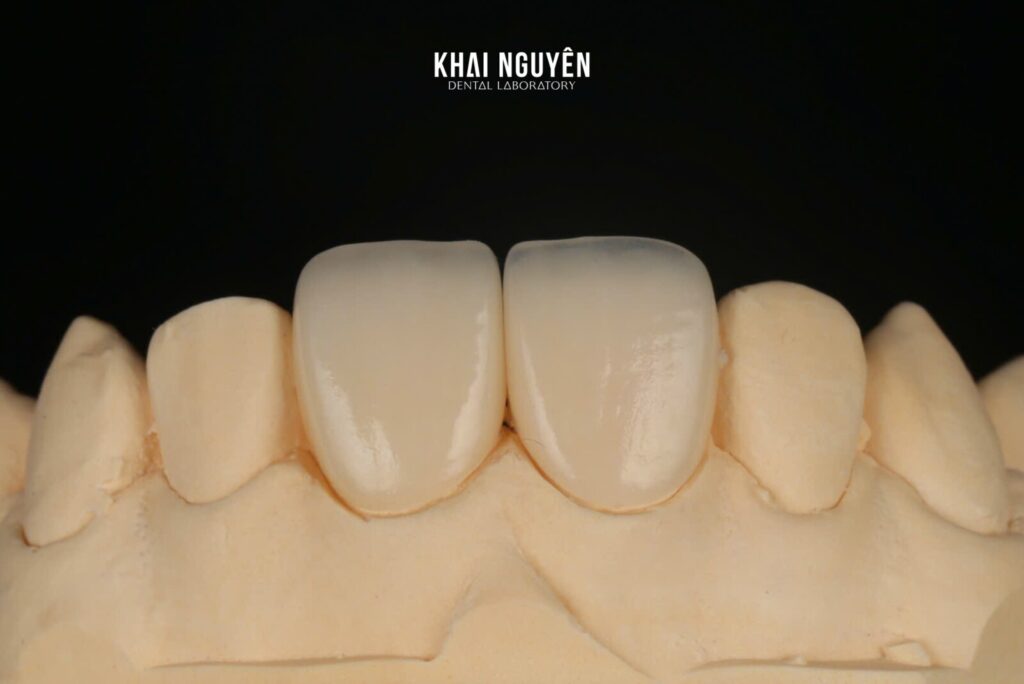
Case fabricated at Khai Nguyen Dental Lab to the treating dentist’s prescription, published on Instagram @khainguyendentallab on 9 June 2025. No patient-identifying information is included.
Case summary
| Indication | Two pressed ceramic veneers on the central incisors, teeth 11 and 21 |
|---|---|
| Material | IPS e.max Press (Ivoclar) |
| Shade | A1 |
| Main challenge | Matching untreated adjacent teeth in form and shade |
| Photo source | Instagram @khainguyendentallab, 9 June 2025 |
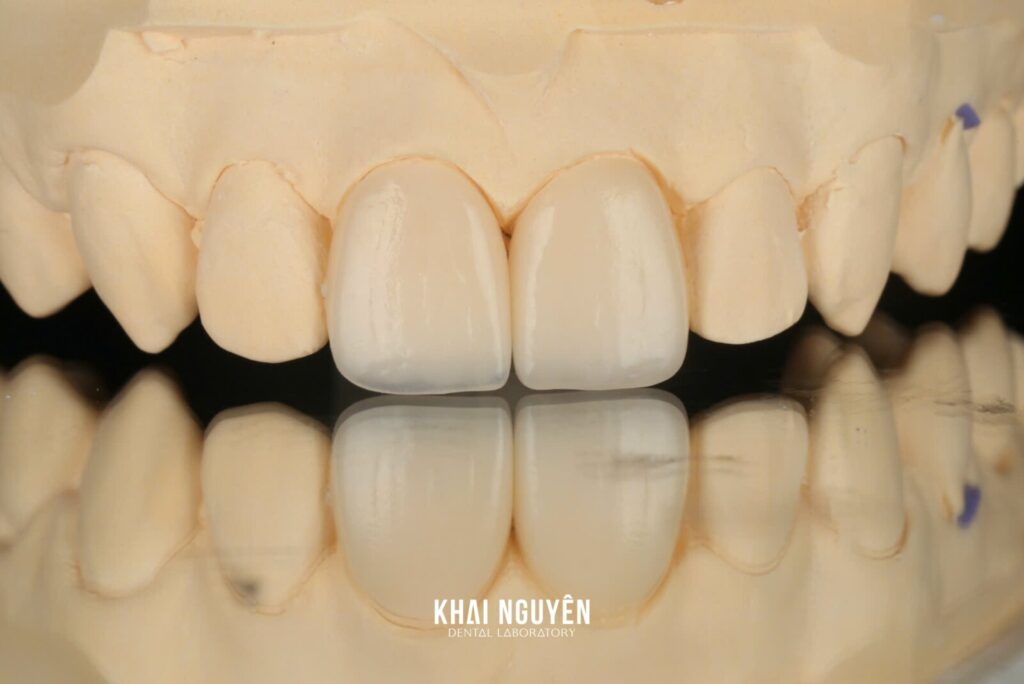
Photo above: the two veneers on the model, frontal view with a mirror reflection.
What the dentist asked for
Two veneers on the upper central incisors in A1, to sit between natural lateral incisors that were not being restored. The goal was a seamless match with the adjacent teeth: subtle incisal translucency and smooth shade transitions, with form and shade precise enough that the two veneers do not stand out.
Why two centrals are harder than ten veneers
When a whole smile segment is restored, the lab sets the shade and form for every visible tooth. With two centrals, the natural laterals and canines become the fixed reference, and any difference in value, translucency or surface lustre shows immediately at the midline, where the eye looks first.
That makes three things decisive in a case like this:
- Symmetry between 11 and 21. Length, width, incisal outline and the position of the line angles have to mirror each other, because the two centrals are compared side by side.
- Value before hue. A veneer that is slightly too bright stands out more than one that is slightly off in hue, so value is matched to the neighbours first.
- Controlled incisal translucency. The translucent zone at the edge has to resemble the adjacent teeth: too much reads as grey, too little as opaque.
Material choice
IPS e.max Press offers several translucency levels, so the pressed core can be chosen to suit the preparation and the neighbouring teeth before any layering. How the pressed systems differ is set out in e.max Press vs LiSi Press vs Vintage LD Press. A related single-unit case, an e.max crown placed between natural teeth, is described in a single e.max crown between natural teeth.
Notes for prescribing one or two anterior veneers
- Photograph the shade tab next to the adjacent teeth, at the same distance and angle, and add a cross-polarised photo if you can. See dental photography for the laboratory.
- Describe the incisal edge of the neighbours: translucent, opaque, with or without a halo. This is the detail most often missing from a prescription.
- Tell the lab the preparation shade if it differs from the neighbours; it changes which pressed core is suitable. Our article on minimum veneer thickness explains why.
Send an anterior case via WhatsApp +84 902 945 585 or read the ordering process. Dental laboratories can also send this kind of case to us lab-to-lab, shipped white-label.
Written for dentists and technicians. Khai Nguyen Dental Lab manufactures to clinical prescription only and does not sell directly to patients.