


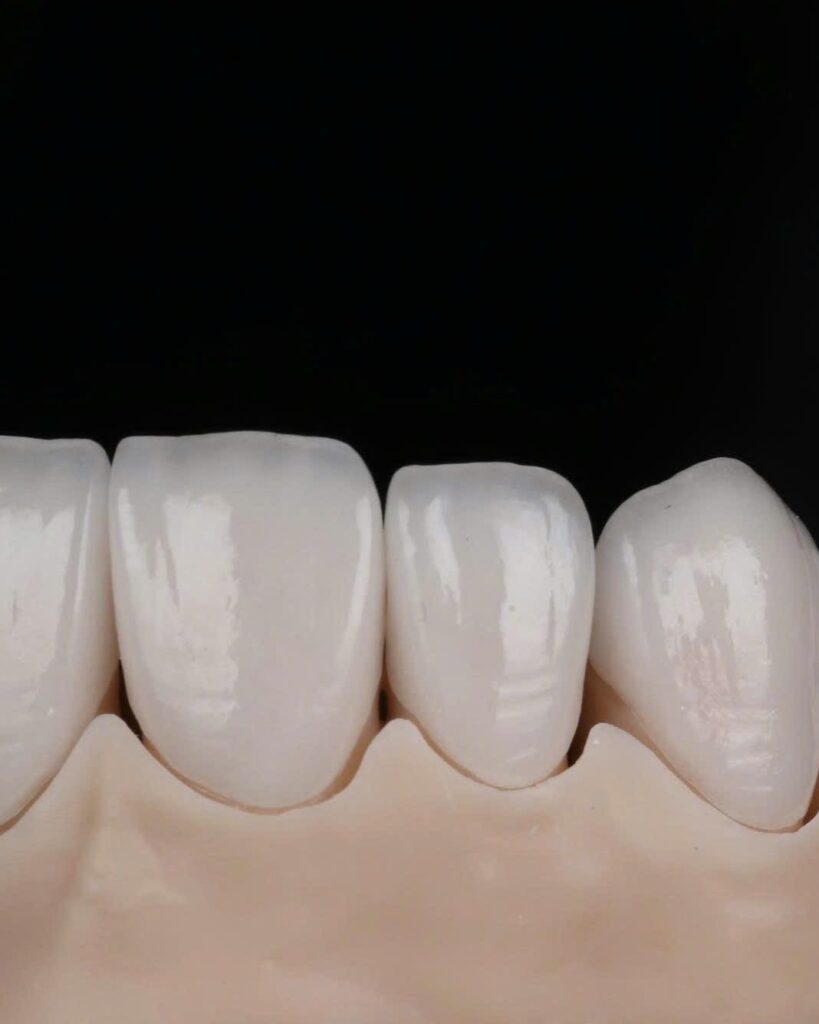
The question “how thin can a veneer go” is usually asked the wrong way round. There is no single correct figure, because minimum thickness is not a property of the material. It is what falls out of three things together: how far the shade has to move, what colour the preparation is, and how much restorative space actually exists.
The 0.2 mm per shade group rule
The literature offers a working rule: each shade group change needs a minimum of 0.2 mm, and ideally 0.3 mm, of ceramic thickness.
A worked example makes it concrete. Moving from A3 to A0 is three shade group changes, so the minimum is 0.6 mm and the ideal is 0.9 mm. If the preparation allows only 0.3 mm and the plan still calls for three groups, the arithmetic does not close. That is not a limitation of the laboratory. It is an optical limit of the ceramic layer.
The threshold for masking a severely discoloured preparation
For severe discolouration, published work reports that roughly 0.8 mm of multilayer porcelain is required to mask it. That figure is worth remembering, because it sits a long way from the ultra-thin veneer patients expect after seeing advertising.
When the preparation is dark there are three routes: reduce further to create the space, change to a material with better masking, or revise the target shade to something achievable. There is no fourth route.
Why 0.5 mm keeps appearing
Most veneer preparations reduce enamel by about 0.5 mm. The number is not arbitrary: it is enough for a minimum ceramic thickness while avoiding a restoration that ends up over-contoured relative to the original tooth. Reduce less and either the ceramic is too thin, or the veneer builds out beyond the natural outline.
The literature adds a fabrication note: below 0.3 mm is very difficult to produce, and for most materials 0.5 mm is the realistic minimum.
Minimum workable thickness by material
| Material | Workable thickness | Note |
|---|---|---|
| Hand-layered feldspathic | 0.2–0.3 mm | The thinnest, but masks almost nothing |
| Lithium disilicate (e.max) | 0.4–0.5 mm | Higher-opacity ingots available for masking |
| Zirconia | 0.5 mm and above | Best masking, lower translucency |
This table describes what can be fabricated, not what should be prescribed. Being able to make 0.2 mm does not mean 0.2 mm is the right answer.
When 0.2 mm is the right answer
We produced a 0.2 mm ultra-thin feldspathic veneer on tooth 21. What matters there is not the number but why that case allowed it.
It was a diastema closure. The existing tooth shade was already correct, so no shade group had to be crossed and nothing had to be masked. The entire 0.2 mm went into form rather than colour. Once the problem is form alone, the thin limit drops a long way.
Move that same case to a patient with an A4 preparation who wants 1M1, with the same material and the same technician, and 0.2 mm becomes impossible. See masking a dark A4 preparation to 1M1 for the opposite situation.
What to send so the lab can answer precisely
- The preparation shade after cutting, photographed with a shade tab, taken before the tooth dehydrates.
- Measured restorative space at the thickest and thinnest point, measured rather than estimated.
- The target shade agreed with the patient.
With those three figures the lab can say immediately how thin the case can go, or how much further reduction it needs. Without one of them, any answer is a guess.
See feldspathic veneers, feldspathic or e.max, or contact our team.
Written for dentists and technicians. Khai Nguyen Dental Lab manufactures to clinical prescription only and does not sell directly to patients.