


A ten-unit feldspathic case, which belongs to the most demanding esthetic group a laboratory receives.
Why ten units is harder than ten times one unit
A single feldspathic veneer is difficult because it has to match its neighbours. With ten units the problem inverts: there is no natural tooth left to match, but now the lab has to create deliberate difference between the teeth.
No two teeth in a natural dentition are identical. Central incisors are brighter and more translucent at the edge; lateral incisors are smaller and usually more translucent throughout; canines are more saturated with a pronounced facial convexity. Build all ten to one shade recipe and the result is perfectly uniform, and therefore reads as false.
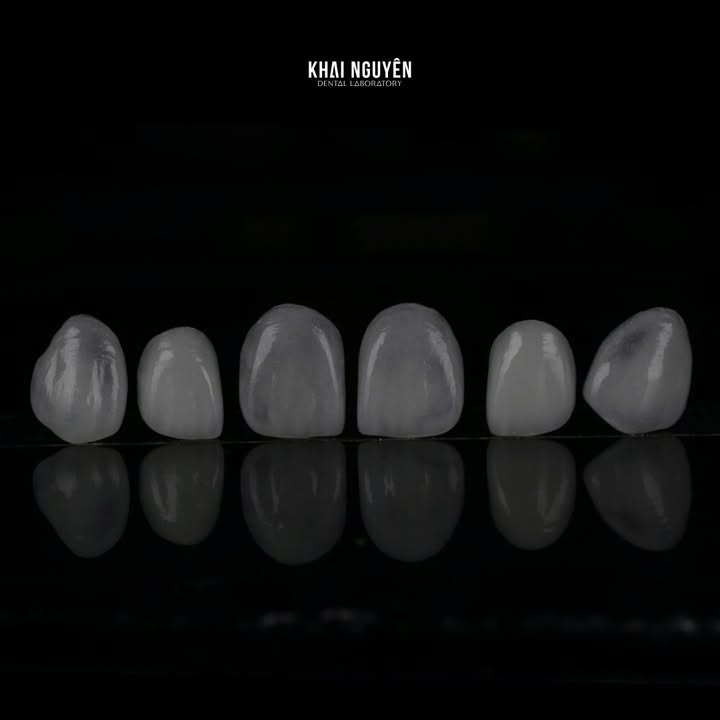
The hardest part: translucency
Natural enamel is neither transparent nor opaque. It scatters light, producing a brighter incisal zone with a thin halo, and lets the dentine colour beneath show through cervically. In hand-layered ceramic that effect is built by stacking materials of differing opacity in the right order, and there is no way to correct it after firing.
What clinicians can use from this
For a multi-unit anterior case, send the lab natural smile photographs, not only retracted intraoral views. Smile line, tooth display in speech and the relationship with the lower lip are only visible in a portrait, and they determine the length and inclination of all ten units.
See feldspathic veneers, or contact our team.
Choosing between the two materials? See feldspathic or e.max veneers: how to choose.
Written for dentists and technicians. Khai Nguyen Dental Lab manufactures to clinical prescription only and does not sell directly to patients.