

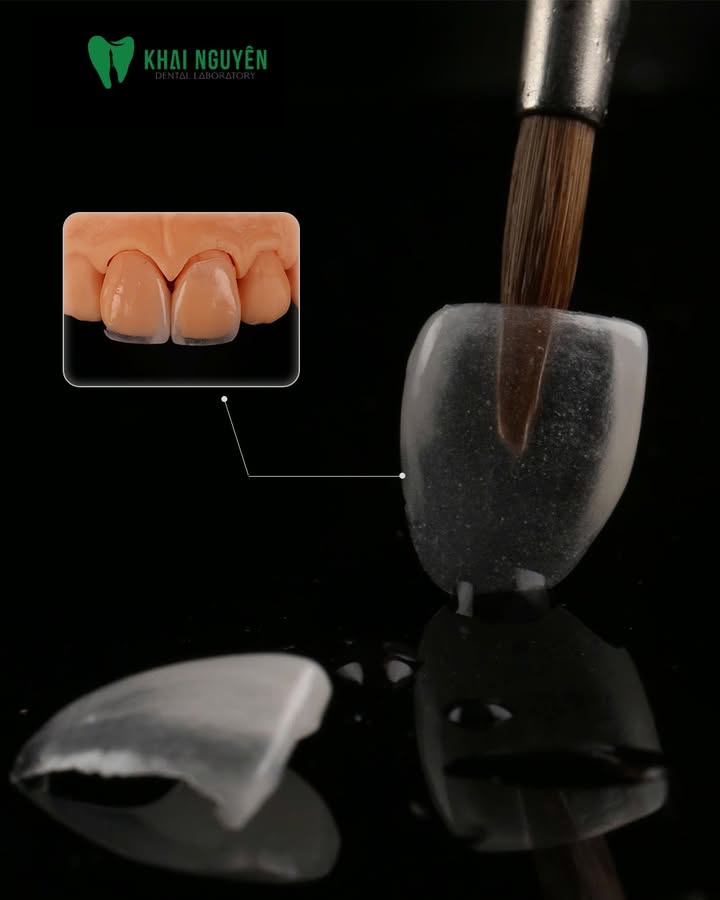
Almost every anterior veneer case passes through this question: prescribe feldspathic or e.max. This note does not answer with “which is better”, because both are good inside their own indication. It sets out a decision procedure instead.
The core differences
| Criterion | Feldspathic | IPS e.max (lithium disilicate) |
|---|---|---|
| Flexural strength | about 60–90 MPa | about 360–400 MPa |
| Minimum workable thickness | 0.2–0.3 mm | 0.4–0.5 mm |
| Translucency | highest, closest to natural enamel | high, several translucency levels available |
| Fabrication | hand layered, no CAD/CAM | pressed or milled, can be cut back and layered |
| Ability to mask a preparation | limited | good, higher-opacity ingots available |
| Dependence on the bond | total | high, with a margin from material strength |
When feldspathic is the right call
When the enamel is intact, the preparation is not badly discoloured, and the change required is moderate: closing a diastema, refining form, lifting shade a little. In this group, being able to build at 0.2 to 0.3 mm allows a non-prep or minimal-prep approach, and the high translucency gives the closest match to natural enamel.
Feldspathic is particularly suited to one or two units sitting between natural teeth, because the restoration then has to reproduce exactly how the adjacent enamel scatters light.
When e.max is the safer choice
When at least one of the following applies:
- A dark preparation has to be masked. At 0.3 mm, feldspathic does not have the material to block the underlying colour. e.max offers higher-opacity ingots for this.
- Generous restorative space. If the preparation is already 0.5 mm or more, the thinness advantage of feldspathic no longer applies, while the higher strength of e.max is a real gain.
- Bruxism or heavy occlusal load. Both materials call for a protective splint, but e.max has the wider safety margin.
- The finish line reaches dentine. Where the bonding substrate is no longer entirely enamel, choose the material that depends less on the bond.
Three figures that decide it
The specific thickness thresholds for each level of shade change are in minimum veneer thickness.
In practice three numbers settle the material choice, and the lab needs all three before production starts:
- The actual preparation shade, photographed with a shade tab. Not the original tooth shade, the shade of the preparation once it is cut.
- Measured restorative space at the thickest and the thinnest point.
- The target shade agreed with the patient.
If the gap between preparation shade and target shade is large while the restorative space is tight, no material resolves that, and the treatment plan needs revisiting.
Cases
See our 0.2 mm ultra-thin feldspathic case for where the thin limit sits, and masking a dark A4 preparation to 1M1 for the situation that forces a change of material.
Material detail is on the feldspathic veneer page and the IPS e.max Press page, or see the full ceramic comparison.
Written for dentists and technicians. Khai Nguyen Dental Lab manufactures to clinical prescription only and does not sell directly to patients.