

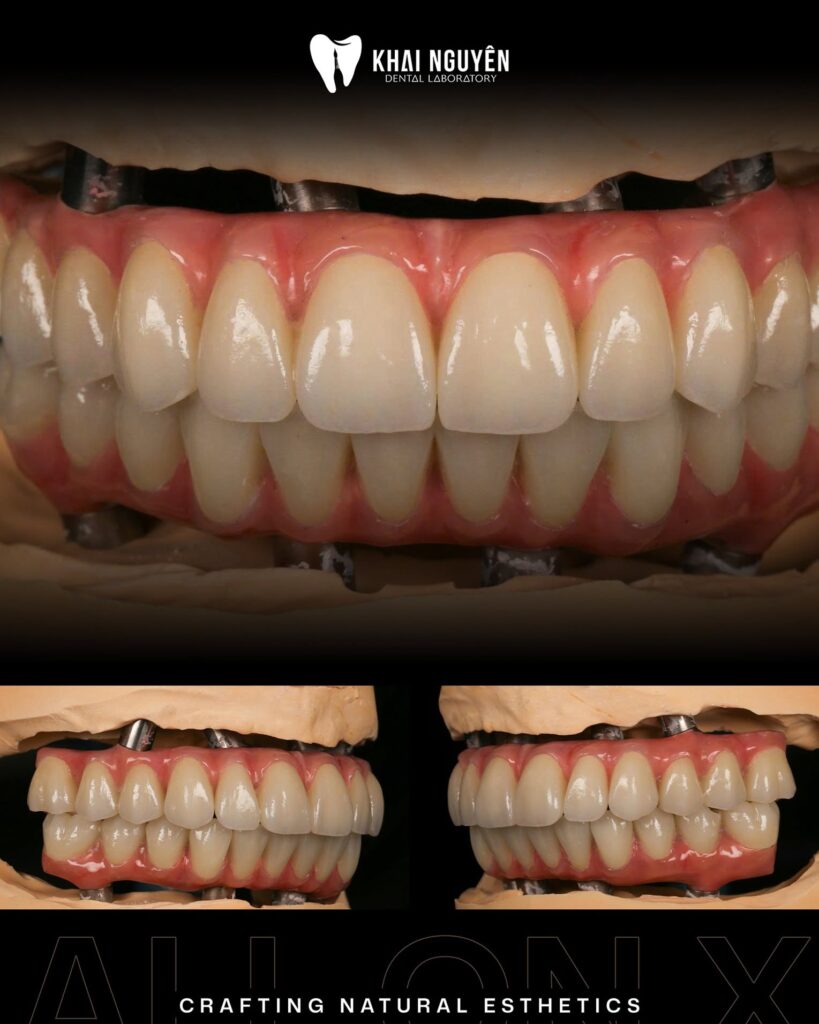
Case fabricated at Khai Nguyen Dental Lab to the treating dentist’s prescription. Photos were taken by the lab on the model and first published on Instagram @khainguyendentallab on 23 June 2026; no patient-identifying information is included. Written for dentists and dental technicians.
Case summary
| Indication | Fixed full-arch implant restorations (All-on-X), upper and lower |
|---|---|
| Restoration type | Screw-retained full-arch bridges on multi-unit abutments with pink ceramic gingiva |
| Technical focus | Recreating gingival detail and tooth anatomy to the dentist’s clinical requirements |
| Related products | Full-arch zirconia on bar, implant crowns and bridges |
| Photo source | Instagram @khainguyendentallab, 23 June 2026 |
Photo above: Both full-arch bridges on the model with the multi-unit abutments visible above and below; the ceramic gingiva shows a natural margin, papillae and colour gradient.
What the dentist asked for
The patient was fully edentulous in both arches and had been rehabilitated with implants under an All-on-X protocol.
The dentist requested two fixed full-arch bridges with three priorities: the artificial gingiva had to have realistic form (papillae, cervical contour, varying thickness from anterior to posterior), each tooth had to carry its own anatomy rather than a row of identical teeth, and the occlusion of both arches had to be set up together because both restorations were new.
What the lab had to control
In full-arch work three factors decide the outcome: tooth position relative to the face, vertical dimension, and passive fit of the framework on the multi-unit abutments.
The lab received models, bite records and facial photos from the dentist, designed the teeth digitally to check midline, smile line and occlusal plane, and only then went into production. Passive fit was verified on the model with a single-screw (Sheffield) test before the ceramic work was completed.
The gingival portion is often underestimated, yet it decides whether the restoration looks natural in a wide smile. The ceramist layered the pink ceramic in several shades: deeper pink at the vestibular base, lighter at the cervical margin, small darker accents imitating vasculature, and full papillae between the anterior teeth to avoid black triangles.
Lab workflow
- Model and abutment check. Positions of the multi-unit abutments on the model were compared with the scan data, and parallelism and spacing were checked so screw access could be placed occlusally or palatally.
- Digital design of both arches together. Vertical dimension, midline, lip support, tooth arrangement with individual anatomy per position, and canine guidance were set in the design.
- Framework and teeth. The frameworks were milled and checked for passive fit, then the teeth and pink ceramic were finished to the colour map agreed with the dentist.
- Final check. Both arches were tried in on the model, static and excursive occlusion checked, the tissue surface polished for hygiene, and the case photographed before shipping.
Timing for full-arch cases is agreed per case and normally includes one try-in before finishing. See the ordering process for how to prepare an implant case file.
Result
The photos on the model show two full-arch bridges with individually shaped teeth, incisal translucency on the anterior units, and a gingival surface with full papillae and a natural colour gradient from the cervical margin to the vestibular base. The multi-unit abutments visible on the tissue side show the frameworks seated fully on the model.
Lessons for similar cases
- Send frontal and lateral smiling facial photos with the models so the lab positions the teeth to the face, not only to the ridge.
- Agree the gingival shade with a gingiva shade guide or photos of the patient’s natural gingiva under neutral light; a wrong gingival shade is more visible than a wrong tooth shade.
- Plan one try-in. With two completely new arches, a try-in confirms vertical dimension and phonetics before finishing and greatly reduces the risk of a full remake.
Related reading: outsourcing implant work to Khai Nguyen, or message WhatsApp +84 902 945 585.
Written for dentists and technicians. Khai Nguyen Dental Lab manufactures to clinical prescription only and does not sell directly to patients.