

Summary: this is a short guide to what a clinician needs to decide before sending a porcelain veneer case to the lab: which cases suit veneers, which material family to choose, how much to prepare and what to send. Each section links to a detailed article with the manufacturers’ figures and sources.
When veneers are the right choice
- Changing the shape or size of anterior teeth: small teeth, worn incisal edges, diastemas.
- Discoloration that bleaching cannot correct.
- Mild misalignment when the patient does not want orthodontics, or aesthetic finishing after orthodontics.
- Replacing old composite veneers that have stained or chipped.
Take extra care with bruxism, limited remaining enamel or a very dark preparation. All three directly affect material and thickness, so note them on the prescription.
Choosing the material family
We make veneers from three main material families:
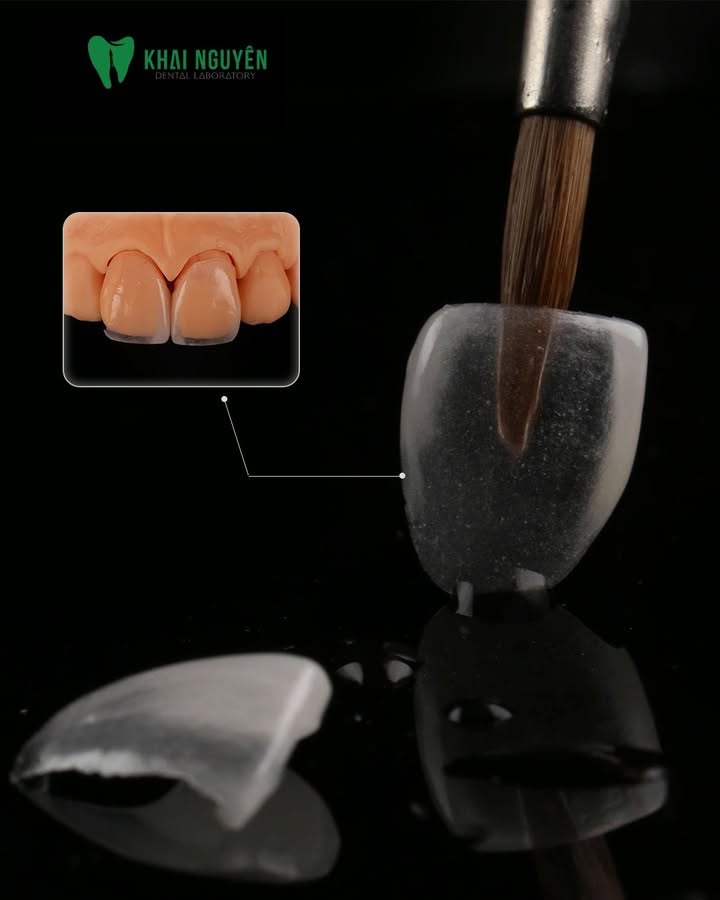
- Hand-layered feldspathic porcelain: can be made very thin, with enamel-like translucency. Suited to minimal-prep or no-prep cases. See our ten-unit feldspathic case.
- Pressed lithium disilicate (IPS e.max Press, GC Initial LiSi Press, Shofu Vintage LD Press): stronger, with good control of thickness and shade. See pressed lithium disilicate compared.
- CAD blocks (IPS e.max CAD, HASS Amber Mill): milled from a digital design, close to the approved wax-up. See ten Amber Mill veneers following the wax-up.
How to choose between feldspathic and e.max case by case is covered in feldspathic or e.max veneers: how to choose.
Thickness and preparation
Minimum thickness depends on the material and on the preparation shade. Getting it wrong leads to fractured veneers or a substrate that shows through.
The thresholds for each material, from the manufacturers’ documents, are in minimum veneer thickness: how thin is enough. Enamel-preserving preparation is covered in minimally invasive preparation for crowns and veneers. For dark preparations, see masking a dark A4 preparation to a bright 1M1.
What to send the lab
- Target shade and stump shade, with photos next to the shade tabs.
- Smile and intraoral photos before treatment.
- An approved wax-up or mock-up, if available.
- Notes on bruxism, occlusion and the preferred material.
How to send a case step by step is on our ordering process page.
Some of our veneer cases
- Feldspathic veneers closing a central diastema
- 20 e.max veneers replacing old composite
- Ten GC Initial LiSi Press veneers in BL2
This article is written for dentists and dental technicians. Khai Nguyen Dental Lab fabricates restorations only on a clinician’s prescription and does not sell directly to patients.