


Written for dentists and dental technicians, based on technical posts by the Khai Nguyen Dental Lab team on Facebook and Instagram (August 2026, October 2025). Case photos were taken by the lab; no patient-identifying information is included.
More patients bleach, so bleach shades such as 0M2, 1M1, 1M2 or BL1 to BL4 now appear on prescriptions more often than A1 or A2. The difficulty is that these tones sit very close in value and differ only in subtle chroma; a restoration that comes back “white but dead” or “white but the wrong tone” usually starts with dentist and lab reading the shade code differently.
This article explains the bleach shade systems, how technicians tune the tone with stains, and how to send shade information so the lab gets it right first time.
Two bleach shade systems in parallel use
| System | Codes | How to read them |
|---|---|---|
| Vita 3D-Master groups 0 and 1 | 0M1, 0M2, 0M3, 1M1, 1M2 | First digit is value (0 is brightest), M is the neutral hue, last digit is chroma (1 low, 2 higher). 1M1 is bright and near neutral; 1M2 has the same value but is warmer; 0M2 is one step brighter than 1M1. |
| Vita Bleachedguide 3D-Master | 0M1 to 5M2 ordered by value | An extended version of the above, arranged to compare before and after bleaching. |
| “BL” guides from some ceramic manufacturers | BL1, BL2, BL3, BL4 | BL1 is brightest. BL2 sits near 0M2 to 1M1; BL3 near 1M2; BL4 near 2M1. These are approximate conversions, not exact equivalents. |
Because the guides are not exact equivalents, write the code from the guide actually used in the mouth and attach a photo with the tab in frame instead of converting by hand.
Stain technique: a small change in ratio changes the tone
At high value the disc or ingot is usually chosen in the most neutral tone, and the technician pulls it to the right chroma with stains before glazing. The Khai Nguyen team’s experience: a slight change in the ratio between the basic stain colours is enough to move from 0M2 to 1M1 or 1M2. Some working rules:
- Go from little to more. Stains on bright shades are easy to overdo; fire a thin layer, compare with the tab under neutral light, then add.
- Warm at the cervical, neutral on the body, slightly blue-grey at the edge. 1M2 differs from 1M1 mainly in the amount of warm colour at the cervical and body; 0M2 differs from 1M1 in value, which stains cannot fix, so the blank must be re-selected.
- Effects are still needed. Real bleached teeth still show an incisal halo, enamel striations and white opacities. Without them a bright arch looks like plastic. See the e.max crown and feldspathic veneers in OM1 case.
- Stains do not replace layering. When depth is required the lab cuts back and layers; stains only fine-tune the tone at the end.
Photo above: A Khai Nguyen technician tuning the tone of a ceramic restoration with stains: small changes in colour ratio separate 0M2, 1M1 and 1M2.
Example: a BL2 case with natural translucency
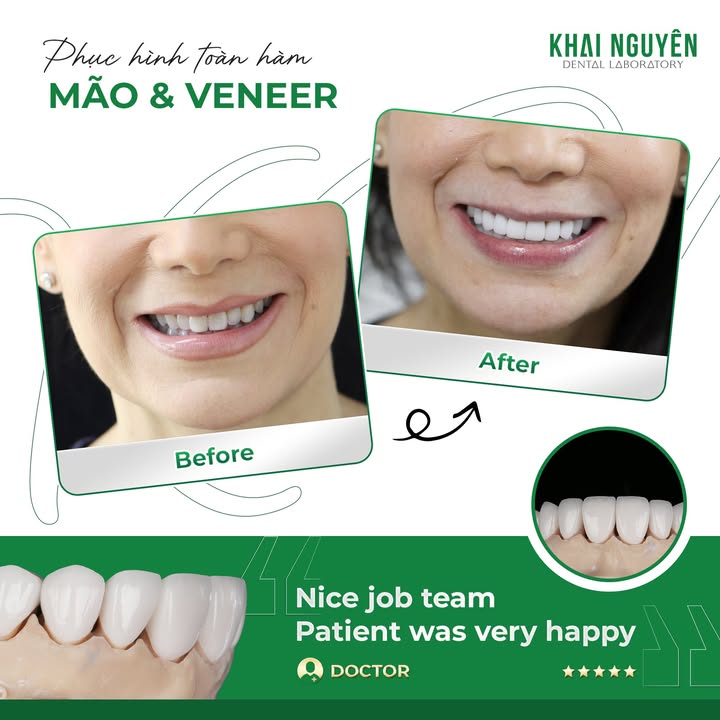
For a veneer case in BL2 the dentist sent a photo of the BL2 tab next to the bleached teeth, a smiling facial photo and the note “white, but translucent at the edge”. The lab chose a medium-translucency pressed ingot in a bright tone, layered translucent porcelain in the incisal third, built a thin halo and used stains only to balance chroma between the units.
The feedback photo after seating shows the BL2 value with a translucent incisal edge, not a solid white block.
How to send bleach shade information to the lab
- Take the shade photo at least two weeks after bleaching ends, because the colour still shifts in that period. Tab in the same plane as the teeth, slightly wet, in daylight or under a 5500 K lamp, never under the operating light.
- Photograph two adjacent tabs (for example 0M2 and 1M1, or BL2 and BL3) so the lab sees whether the patient sits between them or leans one way.
- Say which tooth is the reference: canines are usually darker than incisors; for an incisor restoration, match the contralateral incisor.
- State the desired translucency in words (“clearly translucent edge”, “almost none”) or with a reference photo.
- If the patient will bleach again, choose a target one step lower so the restoration is not darker than the natural teeth a few months later.
Frequently asked questions
Should every bleached patient get 0M1?
No. 0M1 is very bright and looks artificial if the remaining teeth are not equally bright. Match the natural teeth after bleaching, usually 1M1 or BL2, and go to 0M1 or 0M2 only when the whole smile segment is being restored.
Do bright restorations need layering, or is staining enough?
Posterior crowns can be stained monolithic. Anterior crowns and veneers should be layered, or at least cut back at the incisal edge, because bright tones expose any lack of depth.
Are phone photos good enough?
Yes, if a shade tab is in frame, the operating light is off and no filters are used; the tab is the reference that lets the lab correct the camera’s colour cast.
See our comparison of pressed ceramic systems, or send a case via WhatsApp +84 902 945 585.
Written for dentists and technicians. Khai Nguyen Dental Lab manufactures to clinical prescription only and does not sell directly to patients.