

Case fabricated at Khai Nguyen Dental Lab to the treating dentist’s prescription. Photos were taken by the lab and first published on Instagram @khainguyendentallab on 29 May 2025; no patient-identifying information is included. Written for dentists and dental technicians.
Case summary
| Restoration | Fixed full-arch implant restoration: full zirconia overlay on a CAD/CAM-milled titanium iBar |
|---|---|
| Materials | Aidite 3D Pro multilayer zirconia on a titanium bar; pink gingival ceramics |
| Technical focus | Fit between the zirconia overlay and the bar; shade layering and surface characterisation for natural translucency |
| Related product | Full-arch zirconia bonded on bar |
| Photo source | Instagram @khainguyendentallab, 29 May 2025 |
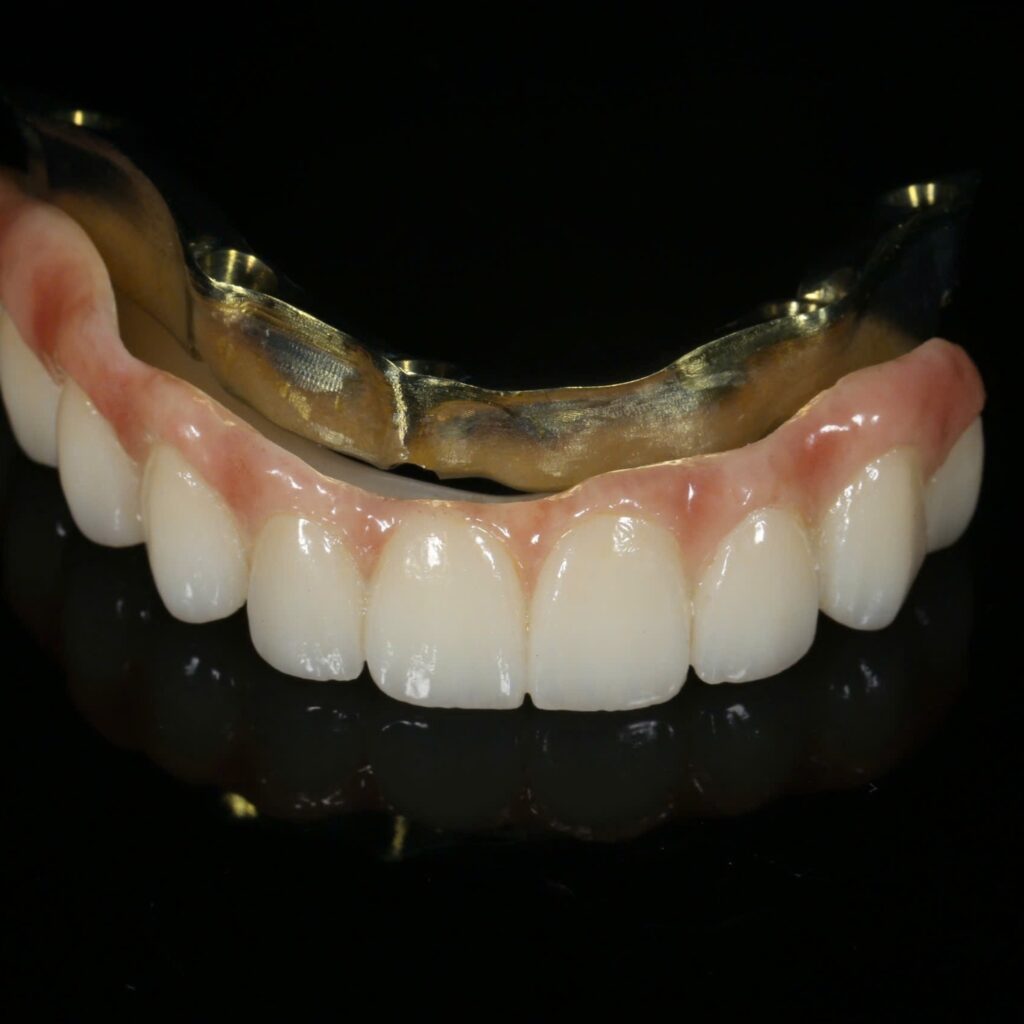
Photo above: frontal view of the full-arch restoration, multilayer zirconia teeth with pink ceramic gingiva showing papillae and a colour gradient.
What the dentist asked for
The patient was fully edentulous in the arch and had implants placed. The dentist chose a CAD/CAM-milled titanium bar screwed to the implants with a full-arch zirconia overlay bonded onto it.
Compared with a monolithic zirconia bridge screwed directly to the implants, this construction separates the load-bearing function (titanium bar) from the esthetic function (zirconia overlay), reduces the risk of zirconia fracture around screw channels, and allows the overlay to be replaced later without touching the bar. The requirements were passive fit on the implants, individual tooth anatomy with natural translucency, and realistic ceramic gingiva.
What the lab had to control
With a bar-and-overlay system two fits must be right: the bar must seat passively on the implants, and the overlay must fit the bar so the bonding cement layer is thin and even. Both are designed in the same file.
The lab set up the teeth in their esthetic position first, then reduced the arch inward to define a bar that supports every tooth without showing through in areas of thin gingiva. The bar was milled from titanium; the overlay from an Aidite 3D Pro multilayer disc so the cervical zone is opaque and the incisal zone more translucent straight from the disc.
Lab workflow
- Model verification. Implant positions on the model were confirmed with a verification jig before design, because any error here becomes a fit error in the bar.
- Teeth and bar designed together. Tooth set-up from the bite record and facial photos for vertical dimension, midline and lip support; the bar designed inside with the minimum overlay thickness respected everywhere.
- Milling and bar try-in. The titanium bar was milled and its passive fit checked on the model with a single-screw test; the zirconia overlay was milled and sintered.
- Esthetic finishing. Layered staining of the teeth, surface texture, pink ceramics in several shades with papillae, then firing and polishing.
- Bonding the overlay to the bar following the cement manufacturer’s protocol, removing excess cement on the tissue side and polishing the tissue-contact surface for hygiene.
Result
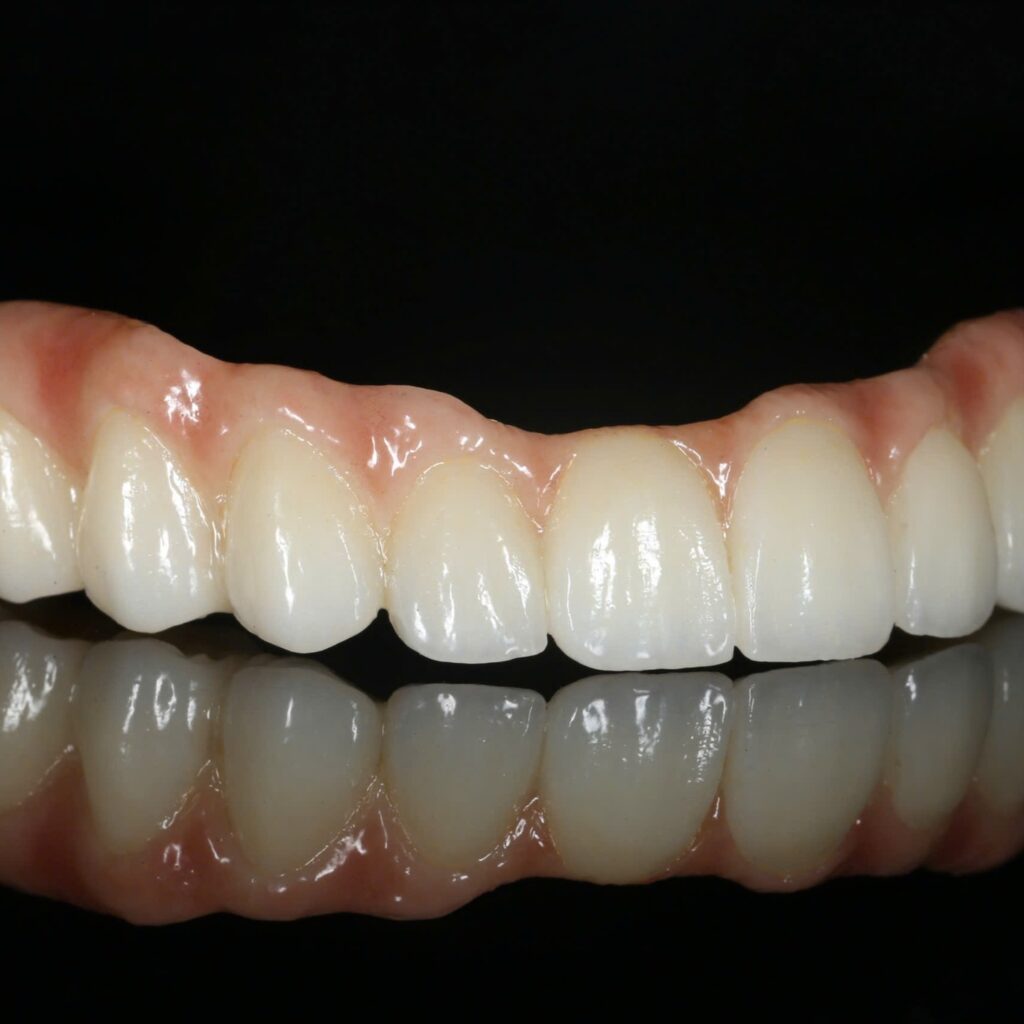
The photos on the model show the zirconia overlay enclosing the bar completely, with the bar visible only on the tissue side at the screw channels. Anterior teeth show incisal translucency, posterior teeth have defined cusps and grooves, and the ceramic gingiva has full papillae and a natural colour gradient. The junction between zirconia and pink ceramic is continuous, without a step.
Lessons for similar cases
- Always send a verification jig or ask the lab to make one for an intra-oral check before the bar is milled; it is the cheapest way to avoid remaking a titanium bar.
- Agree screw-channel positions and overlay thickness in the anterior segment in advance, because the distance from implant to incisal edge decides whether the overlay is thick enough to be translucent.
- Select the gingival shade with a gingiva shade guide from the start; with this much pink ceramic, correcting the gingival shade after bonding is very difficult.
Compare with the All-on-X case screwed directly to multi-unit abutments, or send a full-arch case via WhatsApp +84 902 945 585.
Written for dentists and technicians. Khai Nguyen Dental Lab manufactures to clinical prescription only and does not sell directly to patients.