


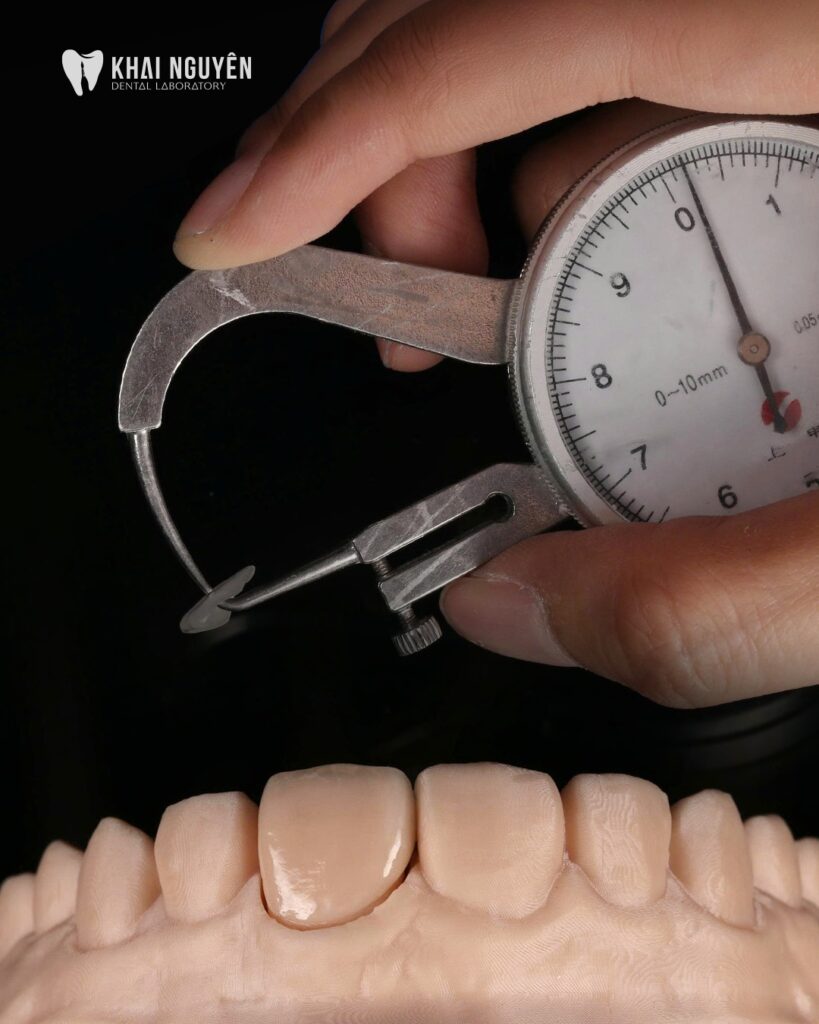
Case fabricated at Khai Nguyen Dental Lab to the treating dentist’s prescription, published on Instagram @khainguyendentallab on 28 April 2026. No patient-identifying information is included.
Case summary
| Indication | A single veneer on tooth 21, closing a diastema and slightly lengthening the incisal edge |
|---|---|
| Material | Hand-layered feldspathic porcelain |
| Thickness | 0.2 mm (ultra-thin), measured with a calliper |
| Goal | Seamless integration with tooth 11 in texture and translucency |
| Photo source | Instagram @khainguyendentallab, 28 April 2026 |
Photo above: measuring the veneer with a calliper, reading 0.2 mm.
Why one veneer is harder than ten
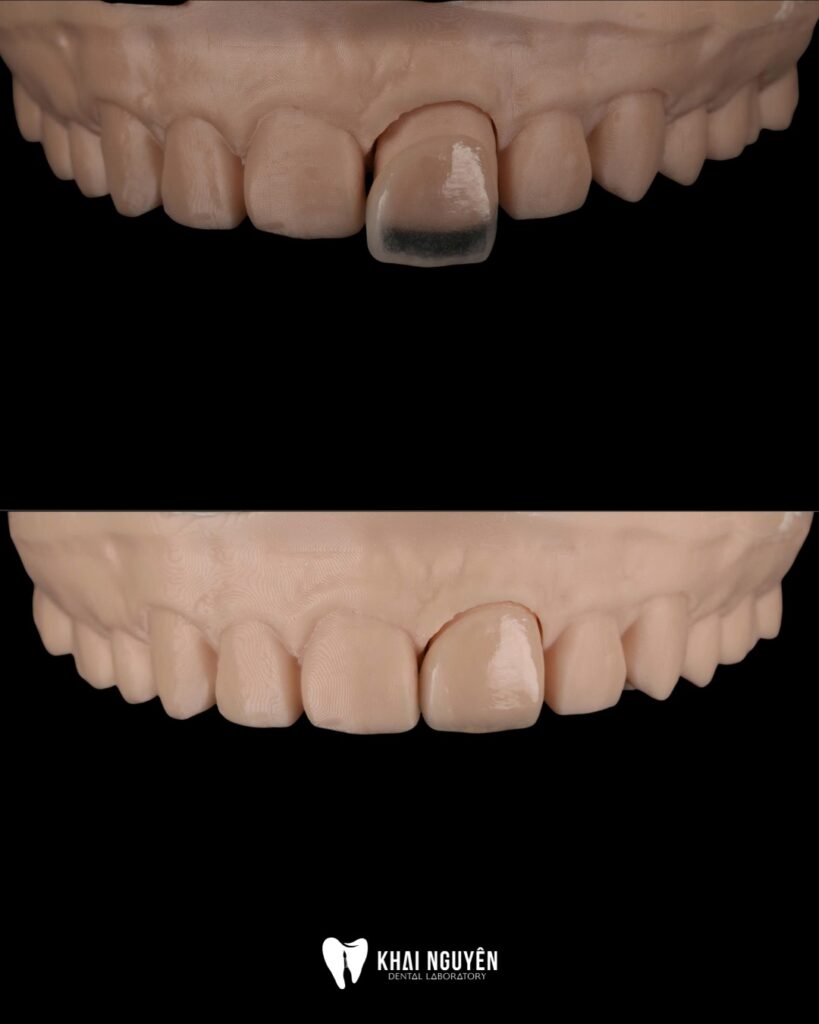
When restoring a whole arch the ceramist sets the rules for shade and effects and applies them consistently. When restoring one tooth next to a natural one, the natural tooth sets the rules: the veneer must copy the translucency, enamel striations, white opacities and light reflection of the adjacent tooth 11.
One detail wrong shows immediately, because the two central incisors sit side by side and are always compared directly.
This case added two form requirements: closing a diastema, so the veneer had to extend mesially, and slightly lengthening the incisal edge to balance tooth 11. Both change the width-to-length ratio, so they must be planned in advance to keep the tooth from looking oversized.
Why 0.2 mm
A thickness of 0.2 mm is close to the limit for a ceramic veneer. The advantages are almost no tooth reduction, bonding entirely to enamel, and retained natural translucency because the layer is too thin to mask colour.
The conditions that come with it: the tooth must be bright and even in colour, since such a thin layer masks nothing; and the whole bonding surface must be enamel, with no exposed dentin.
Only feldspathic porcelain layered on a refractory die reaches this thickness together with real effects; pressed or milled blanks cannot go to 0.2 mm and still survive handling. In return, a veneer this thin is fragile before bonding, so transport and try-in must be careful.
Lessons for single ultra-thin veneers
- Photograph the adjacent tooth in close-up from several angles and under different light sources. This is the most important document, more important than the shade code.
- Check the substrate before prescribing 0.2 mm. With dark spots or an endodontically treated tooth, more thickness and a masking layer are needed.
- Agree the tooth proportions after diastema closure in advance, and say whether a longer contact point is acceptable.
- Prepare the bonding protocol for an ultra-thin veneer: gentle dry try-in, correct surface treatment and a cement chosen per the manufacturer’s instructions.
See the two-veneer diastema closure case for comparison. WhatsApp +84 902 945 585.
Choosing between the two materials? See feldspathic or e.max veneers: how to choose.
The thickness thresholds for each level of shade change are in minimum veneer thickness: how thin is enough.
Written for dentists and technicians. Khai Nguyen Dental Lab manufactures to clinical prescription only and does not sell directly to patients.