

Case fabricated at Khai Nguyen Dental Lab to the treating dentist’s prescription. The before-and-after photos were sent to the lab by the dentist as feedback and first published on Instagram @khainguyendentallab on 23 July 2026; no patient-identifying information is included. Written for dentists and dental technicians.
Case summary
| Indication | Replacement of old anterior crowns in the upper arch, with veneers on the adjacent teeth |
|---|---|
| Materials | Zirconia crowns (see the zirconia systems used at the lab) combined with porcelain veneers |
| Main challenge | Uneven preparation shades between teeth; adjacent teeth with white and brown enamel spots |
| Goal | Block out the preparation shades while preserving natural incisal translucency |
| Photo source | Instagram @khainguyendentallab, 23 July 2026 |
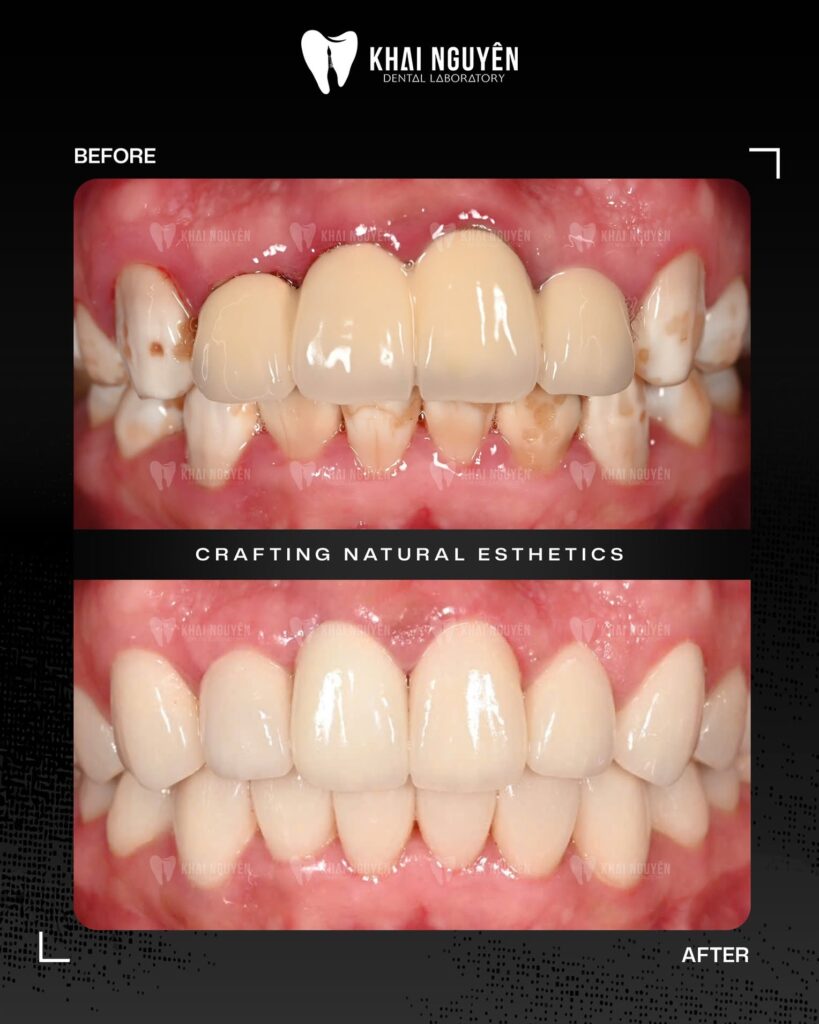
Photo above: Before: opaque, discoloured old crowns with dark gingival margins and mottled adjacent teeth. After: a uniform anterior arch with translucency retained at the incisal edges.
Initial situation
The pre-treatment photo shows the upper incisors carrying old crowns that were highly opaque, yellow compared with the natural teeth, flat in form and with dark gingival margins. The adjacent teeth had multiple white and brown enamel spots of the kind typically seen in fluorosis. The dentist decided to replace the old crowns and restore the neighbouring teeth to create one uniform anterior arch.
The problem for the lab was the substrate. Teeth previously prepared for crowns had different stump shades, some darker after endodontic treatment or metal posts, while the teeth prepared only for veneers had bright but mottled enamel. Using the same opacity for every unit would have produced either a uniformly opaque result that looked artificial, or a uniformly translucent one that showed the differing substrates.
Why a zirconia and veneer combination
For teeth with heavy tissue loss and dark substrates, multilayer zirconia crowns give the best masking of any ceramic family while still offering enough translucency in the incisal third when the right disc is chosen. For teeth with plenty of enamel and only superficial discolouration, thin porcelain veneers are the more conservative option. Our ceramic materials comparison summarises masking ability and translucency by family.
The deciding factor was the colour distance between each stump and the target shade of each tooth. The lab set the opacity of the core individually per unit, then used one porcelain system for the outer layer so the whole arch shared the same translucency and surface texture.
Lab workflow
- Stump shade assessment from the dentist’s photos taken with a stump shade guide in frame.
- Digital design of the whole anterior group at once to unify incisal edge length, smile line and the labial position of crowns relative to veneers.
- Opacity per unit: multilayer zirconia for the teeth with dark substrates; a thin masking layer under the veneers on teeth with darker spots.
- Shared outer layer on crowns and veneers, building incisal translucency and consistent enamel striations across the arch.
- Checks under several light sources so the units do not separate visually when the lighting changes, especially with light transmitted through the incisal edges.
Result
The post-seating photo sent by the dentist shows a uniform anterior arch from canine to canine, an even pink gingival margin, retained incisal translucency and subtle enamel striations. The enamel spots no longer show through the restorations. In the full view, zirconia crowns and veneers cannot be distinguished.
Lessons for similar cases
- Always send stump shade photos when any tooth has been root-treated or carries a post. Without them the lab has to guess the opacity and the remake risk is high.
- Prescribe the whole group on one form rather than sending crowns and veneers separately, so the lab designs and layers them together.
- Allow an extra 0.1 to 0.2 mm of labial reduction on very dark substrates so the lab has room for a masking layer without over-contouring.
Read more on choosing zirconia discs in 3Y-TZP vs 5Y-PSZ zirconia, or message WhatsApp +84 902 945 585.
Written for dentists and technicians. Khai Nguyen Dental Lab manufactures to clinical prescription only and does not sell directly to patients.