


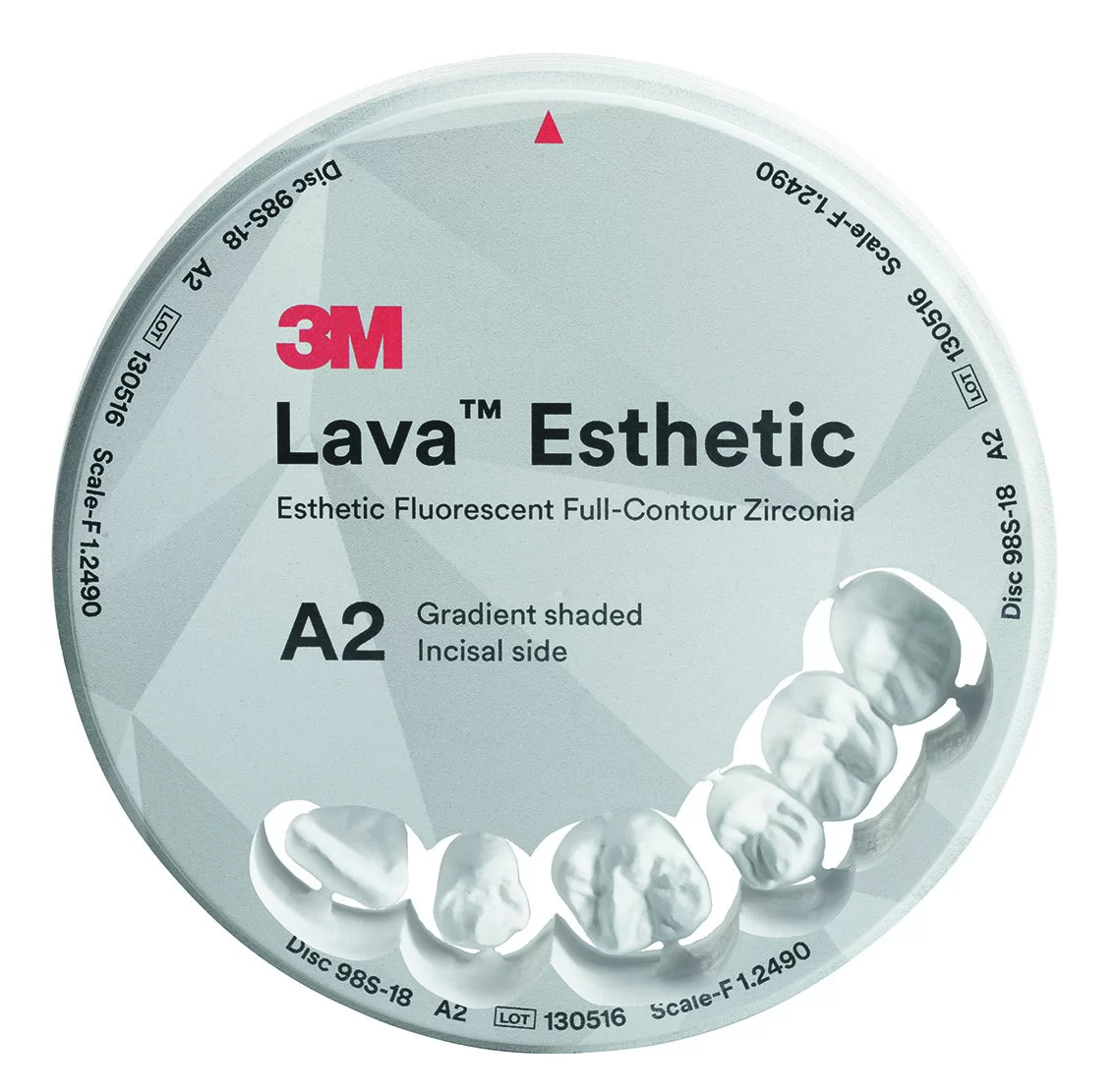
TL;DR: 3Y-TZP zirconia (about 3 mol% yttria) reaches 1,200–1,300 MPa but is opaque, so it is used for long-span bridges, molars and implant prostheses. 5Y-PSZ (about 5 mol% yttria) is far more translucent but drops to around 800 MPa, so it is used for monolithic crowns in the esthetic zone and short bridges.
Multilayer discs with 3Y in the dentin zone and 5Y at the incisal edge are today’s most common choice for monolithic full-arch work. This article explains the structural difference, indications, minimum thickness and how to choose between the discs used at Khai Nguyen Dental Lab.
Yttria decides both strength and translucency
Dental zirconia is ZrO2 stabilised with yttria (Y2O3). At 3 mol% the material is mostly tetragonal and benefits from transformation toughening: when a crack starts, tetragonal grains around it transform to the monoclinic phase, expand, and squeeze the crack shut. That is why 3Y-TZP reaches 1,200–1,300 MPa.
Raising yttria to 5 mol% adds cubic phase, which is optically isotropic and scatters less light, hence the higher translucency, but the cubic phase has no transformation toughening, so strength falls to about 800 MPa and fracture toughness is lower. 4Y sits between the two.
Comparison table
| Criterion | 3Y-TZP | 5Y-PSZ | Multilayer (3Y dentin / 5Y incisal) |
|---|---|---|---|
| Discs at Khai Nguyen | DD Bio Zirconia, Cercon ht | 3M Lava Esthetic | IPS e.max ZirCAD Prime |
| Flexural strength (datasheet) | 1,150–1,300 MPa | 800 MPa | 1,200 MPa (dentin zone) |
| Translucency | Low to medium | High, close to LT glass ceramic | Gradient from opaque cervical to translucent incisal |
| Minimum thickness (general guidance) | 0.5 mm posterior walls; 0.6–0.8 mm anterior | 0.8–1.0 mm | 0.6–0.8 mm |
| Bridge connectors | Smallest (per datasheet, often 9 mm² posterior) | Larger; manufacturers limit span | Connector should sit in the 3Y layer |
| Indications | Long-span bridges, molars, full-arch implant prostheses, layered frameworks, bruxers | Monolithic anterior and premolar crowns, 3-unit anterior bridges, zirconia veneers | Monolithic full-arch crowns, 3–4 unit bridges, implant restorations in the esthetic zone |
| Avoid for | Monolithic incisor crowns needing high translucency (unless layered) | Molar bridges, thin walls, severe bruxism | Very long spans where connectors fall in the 5Y layer |
| In-lab time | 2–4 working days for stained and glazed monolithic crowns | ||
Four clinical consequences
1. Do not borrow 3Y strength for a 5Y disc
Many dentists prepare 0.5 mm out of habit with conventional zirconia and then ask for a crown “as translucent as e.max”. With 5Y, a 0.5 mm wall is below the manufacturer’s safe minimum. If translucency is needed, prepare 0.8–1.0 mm or choose a multilayer disc.
2. Bridges: connectors must sit in the 3Y layer
With multilayer discs the technician nests the bridge so the connectors fall in the 3Y dentin layer. Long posterior bridges should be full 3Y, stained, or layered in the esthetic zone.
3. Antagonist wear depends on polishing, not on yttria
Both 3Y and 5Y are kind to opposing enamel when the occlusal surface is mirror-polished. Chairside occlusal adjustment without re-polishing is the main cause of opposing wear.
4. Low-temperature degradation mainly concerns 3Y
The tetragonal phase of 3Y can slowly transform to monoclinic in a moist environment over years; modern discs add a small amount of alumina to limit this. 5Y, with more cubic phase, is less sensitive. Clinically this is not a reason to avoid 3Y posteriorly.
Quick picker
- Long spans, molars, All-on-X, bruxers: 3Y (DD Bio).
- Monolithic anterior crowns needing maximum translucency on non-discoloured abutments: 5Y (3M Lava Esthetic).
- Full-arch monolithic, 3–4 unit bridges, no trade-offs: multilayer (e.max ZirCAD Prime).
- Heavily discoloured abutments or metal posts: 3Y or multilayer with an opaque cervical layer; consider layering anteriorly.
See also the comparison of zirconia with lithium disilicate and feldspathic, our workshop on indicating zirconia in digital dentistry, and the case-by-case zirconia selection service.
Frequently asked questions
Is 4Y the best of both?
4Y-PSZ (about 900–1,000 MPa) is a reasonable compromise for single crowns and short bridges, but multilayer 3Y/5Y discs solve the same problem while keeping 3Y in the load-bearing zone, so our lab prefers multilayer.
Can zirconia be bonded like e.max?
Zirconia cannot be etched with HF. The recommended protocol is low-pressure alumina air abrasion (50 μm), an MDP-containing primer, then resin cement. For retentive preparations, resin-modified glass ionomer is acceptable.
Can zirconia be used for veneers?
Yes, with 5Y at 0.5 mm or more when masking is needed, but ultra-thin veneers below 0.4 mm should still be lithium disilicate or feldspathic.
If you are weighing up an overseas partner in the first place, start with our guide to Vietnam dental lab outsourcing. Send a case for disc advice through the ordering process or WhatsApp +84 902 945 585.
Written for dentists and technicians. Khai Nguyen Dental Lab manufactures to clinical prescription only and does not sell directly to patients.