


Part of the “1001 questions at the lab” series produced by the technicians of Khai Nguyen Dental Lab for young technicians and for dentists who want to understand how ceramic restorations are finished. The first episode was published on the lab’s Facebook page in May 2026.
“Glaze or polish?” is the question new technicians ask most at the finishing stage, and it is also what dentists wonder when one crown arrives mirror-shiny and another has the soft lustre of a natural tooth. The two techniques produce surfaces that differ in optics, roughness and longevity, and they are not always interchangeable.
Two techniques, two kinds of surface
| Glazing (firing) | Mechanical polishing | |
|---|---|---|
| Method | A thin layer of glass (glaze paste or spray) is applied and fired below the porcelain firing temperature; the glass flows and levels the surface | Rubber points, discs and polishing pastes (fine diamond, aluminium oxide) are used from coarse to fine until the surface shines on its own |
| Resulting surface | Very glossy and uniform, tending towards a mirror; the glass fills micro-texture, so texture is softened | Soft lustre that keeps the striations and texture the technician created; gloss can be varied by zone |
| Durability of the gloss | The thin glass layer can wear over the years or be removed when the dentist adjusts the occlusion; the adjusted area becomes rough | The gloss is in the ceramic itself; after adjustment, re-polishing restores it |
| Effect on opposing teeth | Fresh glaze is very smooth, but worn glaze exposes rough ceramic underneath that can abrade opposing enamel, especially with zirconia | Well-polished zirconia is considered kinder to opposing enamel than glaze-only zirconia |
| Time | Fast, one firing for many units | Labour-intensive, unit by unit and zone by zone |
Photo above: A Khai Nguyen technician polishing a ceramic crown mechanically: the gloss is created in the ceramic itself, independent of any glaze layer.
When to use which
Glazing suits
- Stained monolithic posterior restorations that need a sealed surface quickly.
- After staining, because stains need a firing to fix them and the glaze protects the colour underneath.
- Layered porcelain with fine porosity after the last firing; glaze seals it.
Mechanical polishing suits
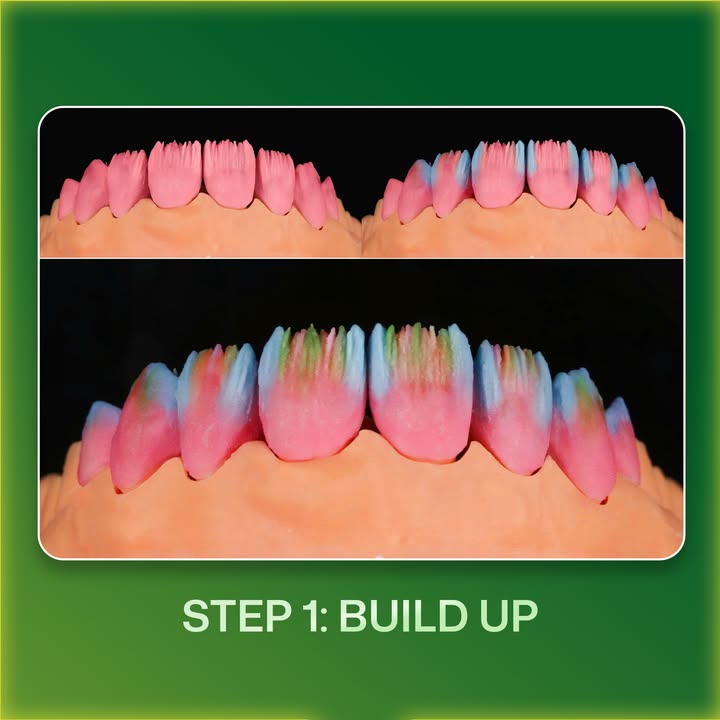
- Anterior veneers and crowns that must keep hand-made surface texture (vertical striations, horizontal ridges, reflective planes); a thick glaze erases these details.
- Monolithic zirconia in direct contact with opposing enamel; smoothly polished zirconia causes less wear than worn glaze.
- Occlusal surfaces and contact points that the dentist may adjust at seating; chairside re-polishing restores the gloss afterwards.
Combining both
In most esthetic cases at Khai Nguyen the technicians combine the two: stain and fire a very thin glaze to fix the colour, then polish selectively to reduce gloss where natural teeth are not shiny (cervical zone, between striations) and keep high gloss on the reflective planes.
The result is zone-dependent gloss like a natural tooth rather than uniform shine. For monolithic full-arch work in Aidite 3D Pro multilayer zirconia the process is shorter: stain with the Biomic kit and glaze, since the multilayer disc already provides the effects.
Three common finishing mistakes
- Glaze too thick. A glass-like surface with no texture; on incisors it creates flat reflections that make the teeth look larger. Fix: a thin glaze or none, and polish instead.
- Skipping polishing grades. Jumping from a coarse point to fine paste leaves long scratches under the gloss, visible under oblique light. Fix: work through every grit and check under a raking light after each.
- Occlusal adjustment without re-polishing. The adjusted area exposes rough ceramic that stains and wears the opposing tooth. Fix: a chairside ceramic polishing kit matched to the material, or return the unit to the lab if the area is large.
What the dentist can write on the prescription
- “Soft lustre, keep texture” for anterior teeth; “high gloss” for posterior teeth if the patient prefers it.
- The material of the opposing teeth (enamel, ceramic, composite) so the lab chooses the least abrasive finish.
- A request for photos under oblique light before shipping if surface texture matters.
Read more: three finishing steps on LiSi Press veneers in A1, choosing zirconia discs by case. Send a case via WhatsApp +84 902 945 585.
Written for dentists and technicians. Khai Nguyen Dental Lab manufactures to clinical prescription only and does not sell directly to patients.