Victor Le – Digital Communications Manager, Khai Nguyen Dental Lab

Victor Le

Digital Communications Manager, Khai Nguyen Dental Lab

Digital Communications Manager at Khai Nguyen Dental Lab, with five years in communications and technical content for the dental laboratory field, responsible for editing technical articles together with the lab's technician team.

Articles by Victor Le

Case Study: Full-Arch Vertical Dimension Rehabilitation with a Digital Workflow, 20 ZirCAD Prime Crowns and LiSi Overlays

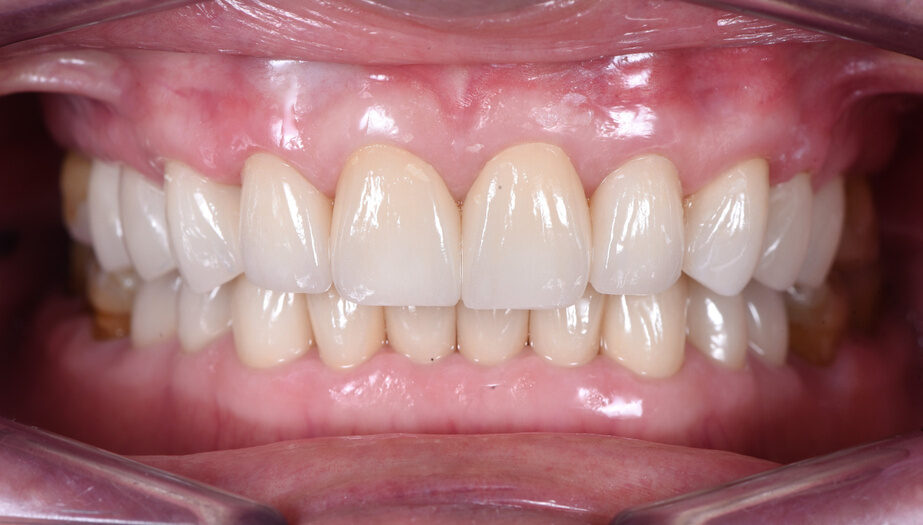
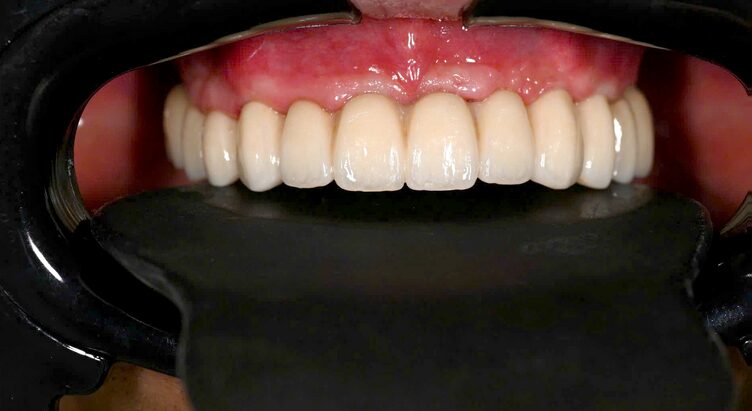
After treatment: 20 ZirCAD Prime anterior crowns at the new vertical dimension

Case fabricated at Khai Nguyen Dental Lab to the treating dentist’s prescription, presented in our laboratory brochure. No patient-identifying information is included.

Case summary

Indication Full-arch vertical dimension rehabilitation after severe tooth wear
Provisionals PMMA overlays raising the bite across all posterior teeth in both arches
Definitive restorations 20 IPS e.max ZirCAD Prime crowns on the anterior teeth; GC Initial LiSi ceramic overlays on the posterior teeth
Workflow 100% digital

Situation

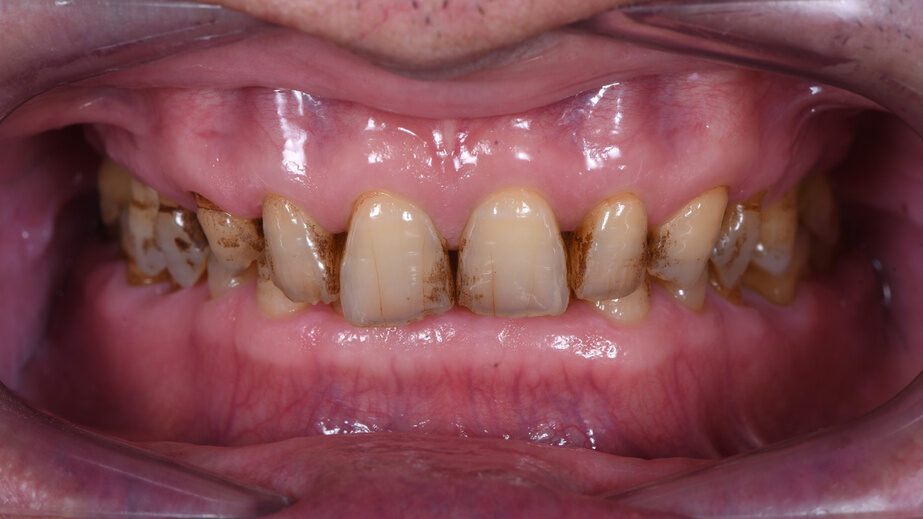
The patient presented with reduced vertical dimension due to severe tooth wear, resulting in:

  • Broken and worn-down teeth: poor esthetics.
  • Ineffective chewing: compromised function.
  • Collapsed bite height: cracked mouth corners and lip soreness.

Treatment

  1. Bite raising with provisionals: PMMA overlays across all posterior teeth, upper and lower, to raise the vertical dimension.
  2. Definitive restorations: 20 ZirCAD Prime crowns on the anterior teeth and LiSi ceramic overlays on the posterior teeth.

The provisional phase gives the dentist and the patient time to confirm the new vertical dimension for function, phonetics and esthetics before moving to ceramics.
Advantages of a 100% digital workflow

  • Less chairside time for impressions and ceramic fabrication.
  • More comfort for the patient during impressions.
  • Higher accuracy throughout the workflow.
  • Full control of margin lines and contact points in ceramic fabrication.
  • Significantly higher patient satisfaction.

Lessons for bite-raising cases

  • Raise the bite with provisionals first, to test the new vertical dimension on the patient before ceramics.
  • Choose materials by region: zirconia for the multi-unit anterior segment, pressed ceramic overlays posteriorly to preserve tooth structure.
  • Send a scan of the accepted provisionals, so the lab carries the exact shape and height into the definitive work.

See also the full-mouth VDO increase with veneers, onlays, crowns and implants case, inlays, onlays and overlays, or contact Khai Nguyen.

Written for dentists and technicians. Khai Nguyen Dental Lab manufactures to clinical prescription only and does not sell directly to patients.
Case Study: All-on-6 FP1 Full-Arch Restoration on AnyRidge Implants for a Patient Living Abroad

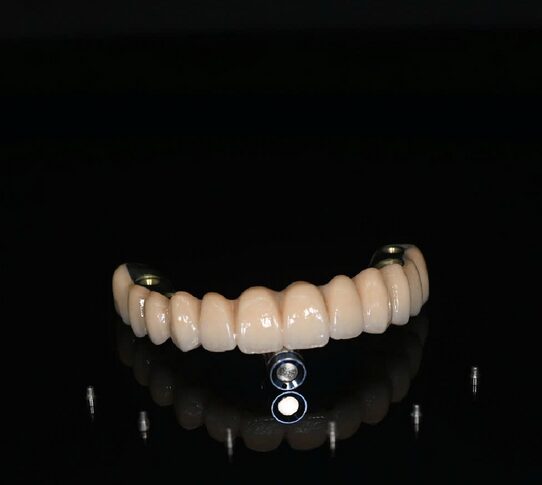
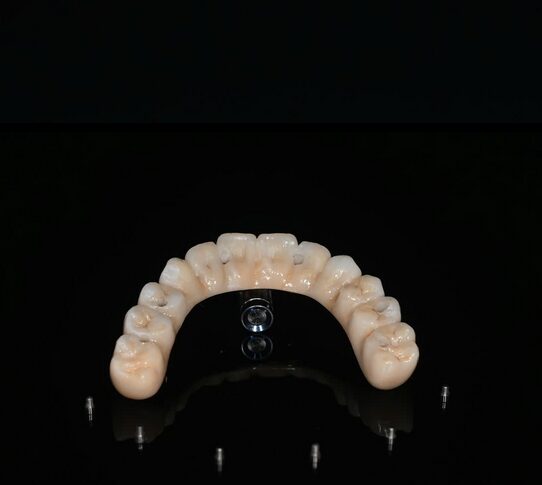
FP1 full-arch prosthesis on six AnyRidge implants, facial view

Case fabricated at Khai Nguyen Dental Lab to the treating dentist’s prescription, presented in our laboratory brochure. No patient-identifying information is included.

Case summary

Indication Fixed full-arch upper restoration, screw-retained on six implants (All-on-6)
Implant system AnyRidge (Megagen)
Design FP1: replaces the crowns only, no pink gingiva
Workflow Immediate loading with a provisional; final impressions and definitive prosthesis at Khai Nguyen

Background

The patient, a Vietnamese American who travels between Vietnam and the US for work, had previous dental treatment, but complications began to appear around October 2023. After clinical evaluation and consultation, he opted for a full-arch upper restoration on six implants for long-term function and improved esthetics.

Treatment plan

  1. The dentist selected the AnyRidge implant system by Megagen.
  2. After implant placement the patient was immediately loaded with a provisional restoration before returning to the US.
  3. In October 2024 the patient returned to Vietnam for final impressions and the esthetic restoration.
  4. The case was completed with a full-arch FP1 prosthesis on six implants, without gingiva, fabricated by Khai Nguyen Dental Lab.

Why FP1 is the harder option

An FP1 prosthesis replaces only the crowns, with no pink porcelain to hide the cervical area, so the cervical contours, embrasures and implant positions must match the patient’s own gingiva. It suits cases where bone and soft tissue allow normal crown length; with greater tissue loss, the prosthesis needs pink gingiva. For a patient living abroad, appointments are few and far apart, so the data sent to the lab at the final impression has to be complete the first time.

Takeaways

  • Send everything at once: scan bodies on every implant, the bite, smile photos and photos of the accepted provisional.
  • Use the provisional as the blueprint for tooth shape and length in the definitive prosthesis.
  • Choose FP1 or pink gingiva by the remaining tissue, not by esthetic preference.

See also implant bridges and crowns, All-on-4 FP1: the polished tissue surface, or contact Khai Nguyen.

Written for dentists and technicians. Khai Nguyen Dental Lab manufactures to clinical prescription only and does not sell directly to patients.

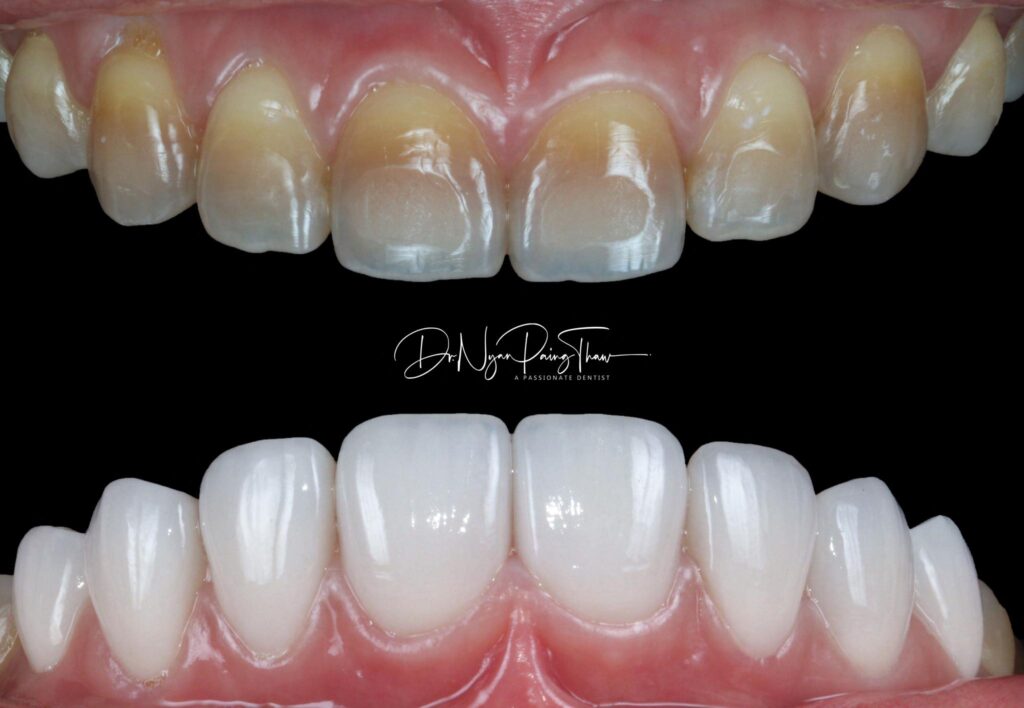
Case Study: 20 e.max Veneers Replacing Old Composite Veneers, with Midline Correction and a Fuller Arch

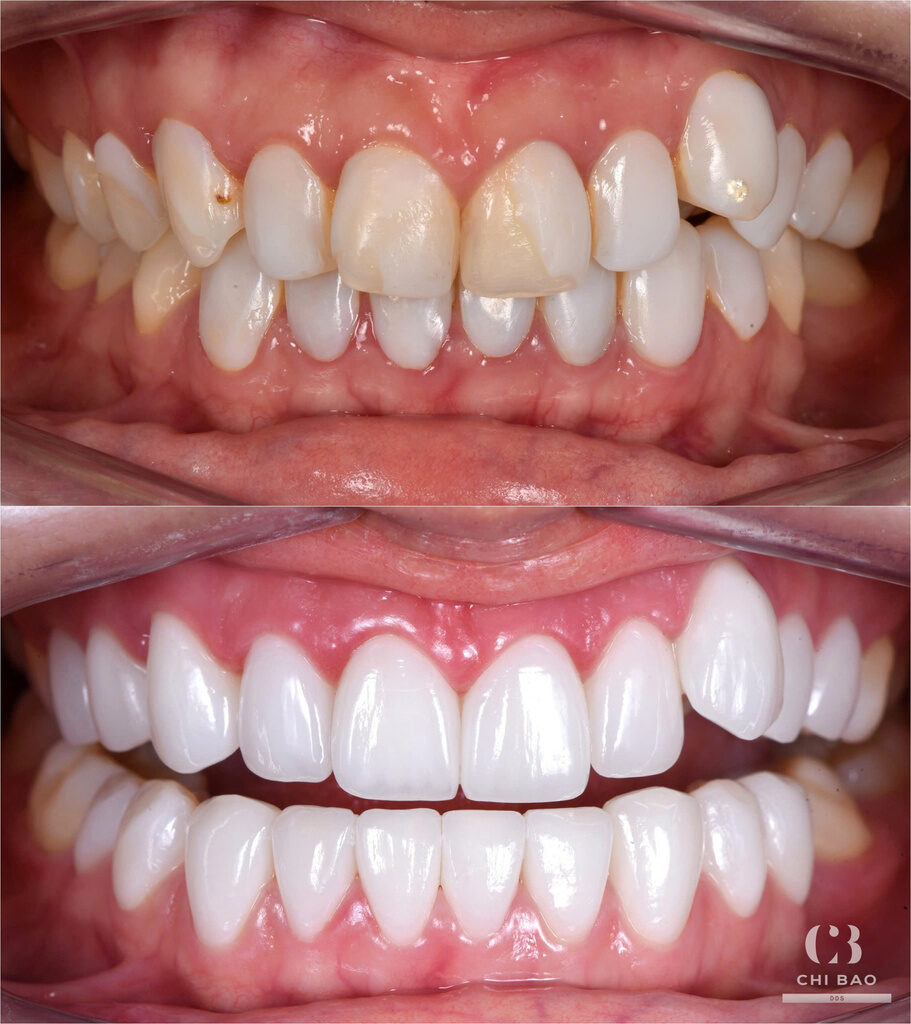
Before and after replacing old composite veneers with 20 e.max veneers, photo by Dr Truong Chi Bao

Case fabricated at Khai Nguyen Dental Lab to the treating dentist’s prescription, presented in our laboratory brochure. Clinical photos: Dr Truong Chi Bao. No patient-identifying information is included.

Case summary

Indication 20 porcelain veneers replacing old composite veneers
Material IPS e.max (Ivoclar), chosen for natural translucency
Technical focus Midline correction, fuller arch form, soft shapes with gentle surface texture
Clinical photos Dr Truong Chi Bao

Situation

The patient came to the clinic with old composite veneers, often marketed as “nano ceramic”. Over time these restorations had caused:

  • Persistent gingivitis and bleeding gums
  • Halitosis
  • Poor esthetics
  • Cracks and breakdown

The patient’s goals

After consultation and evaluation, the patient wanted a healthier, more esthetic smile and chose to replace the old restorations with 20 porcelain veneers, aiming for bright but natural-looking teeth while keeping the natural character of the canines for a more authentic smile.

What the lab did

  • Material: IPS e.max by Ivoclar, selected for its natural translucency.
  • Alignment: repositioned the anterior teeth to the facial midline, which had been off before treatment.
  • Arch design: filled out the arch and lightly expanded the upper teeth for a fuller, more harmonious smile.
  • Tooth form: natural shapes with gentle surface texture and soft incisal curves for a feminine look.

Lessons for replacing old veneers

  • Send portrait and smile photos. Correcting the midline and arch fullness needs facial references, not just models.
  • Agree the shape before ceramics with a diagnostic wax-up and mock-up when the case changes tooth axes or arch form.
  • State the brightness you want and which teeth should keep a natural character, such as the canines here.

See also IPS e.max Press, feldspathic or e.max veneers: how to choose, or contact Khai Nguyen to discuss your case.

Written for dentists and technicians. Khai Nguyen Dental Lab manufactures to clinical prescription only and does not sell directly to patients.

Khai Nguyen Lab and ISO 13485:2016: First Certification and the 2025 Recertification

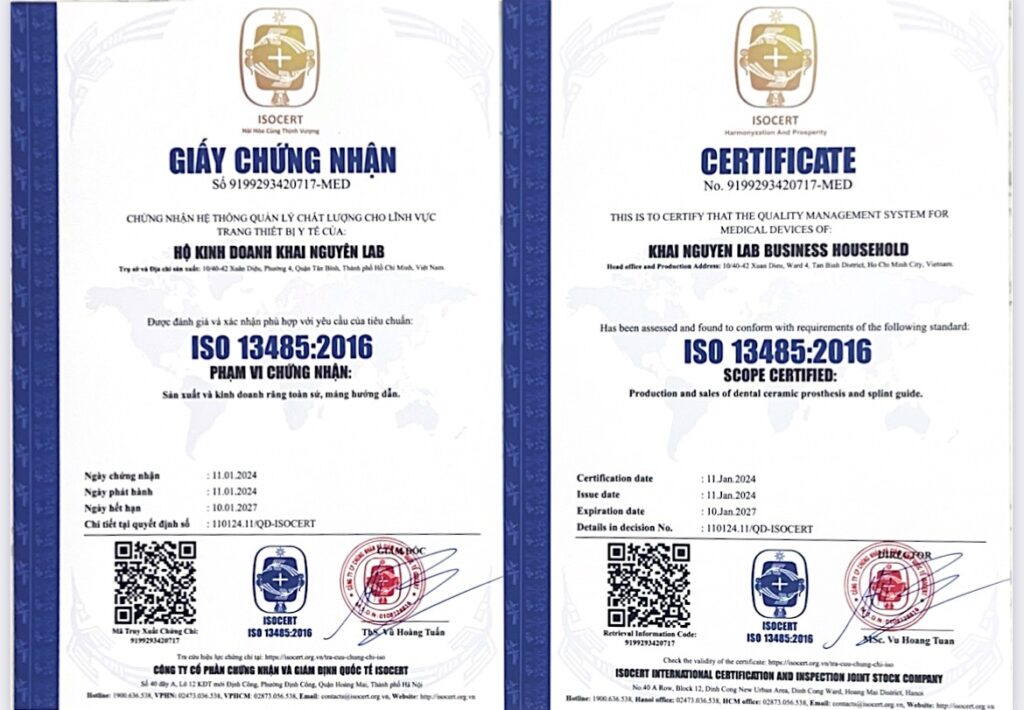
Giấy chứng nhận ISO 13485:2016 số 9199293420717-MED cấp lần đầu ngày 11/01/2024 cho Hộ kinh doanh Khai Nguyên Lab, bản tiếng Việt và tiếng Anh

Update, September 2026: this article was originally published when Khai Nguyen first received ISO 13485:2016 certification in January 2024. The certificate has since been reissued by ISOCERT on 11 March 2025 to Khai Nguyen Dental Lab Co., Ltd with an expanded scope; the current issue, dated 6 April 2026, is valid until 10 March 2028. Full details, the scanned PDF and how to verify it are on our ISO 13485:2016 certificate page.

First certification, January 2024

On 11 January 2024, ISOCERT (International Certification and Inspection Joint Stock Company) issued certificate no. 9199293420717-MED to Khai Nguyen Lab, confirming that the laboratory’s medical device quality management system conforms to ISO 13485:2016, with a scope of “manufacture and trading of all-ceramic teeth and guide splints” (decision no. 110124.11/QĐ-ISOCERT).

What ISO 13485 means

ISO 13485 is the international standard for quality management systems specific to the design and manufacture of medical devices. A dental restoration made to a clinician’s prescription is a custom-made medical device, so the standard applies directly to a dental laboratory.

Holding the certificate means the laboratory’s processes — case intake, design, production, inspection and delivery — are documented, that named individuals are accountable for each, that materials are traceable by batch, and that every piece of clinician feedback is recorded, analysed for root cause and corrected.

Certification timeline 2024 to 2026

Date Event
11 January 2024 First issue to Khai Nguyen Lab; scope: all-ceramic teeth, guide splints (decision 110124.11/QĐ-ISOCERT)
11 March 2025 Recertification to Khai Nguyen Dental Lab Co., Ltd; expanded scope: ceramic veneers, metal-free ceramic restorations, metal-ceramic restorations, implant restorations, removable dentures, dental appliances (decision 110325.02/QĐ-ISOCERT)
6 April 2026 Second issue under decision 060426.03/QĐ-ISOCERT following the annual surveillance audit; ISOCERT reissues the certificate each year, valid until 10 March 2028

Certificate number 9199293420717-MED has been retained across all issues. Validity can be checked on the ISOCERT verification page using reference 9199293420717, or from the scan on our certificate page.

Why an expanded scope matters to a referring clinic

The 2025 recertification widened the scope from two product categories to six. For a clinic sending work from abroad, scope is the practical part of the certificate: it states which categories of restoration are covered by the audited quality system. A certificate whose scope does not name the product you are ordering does not cover that product.

Related reading: is outsourcing dental lab work safe and how to choose a dental lab.

Our thanks go to the whole Khai Nguyen team, whose daily work produced this result, and to the clinicians, clinics and partners who have placed their trust in us. Certification is a starting point, not a destination.

More from Khai Nguyen: Digital restorative seminar, 7 March 2026 · Training and professional exchange 2025–2026 · Silver Sponsor of SYD 2026 · All-ceramic workshop with Ivoclar and Medent · Khai Nguyen Academy · HSDI 2024.

Written for dentists and technicians. Khai Nguyen Dental Lab manufactures to clinical prescription only and does not sell directly to patients.

Veneer Case with Dr Tony Dental — Veneer and Invisalign Center

Dr Tony Dental - Veneer and Invisalign Center

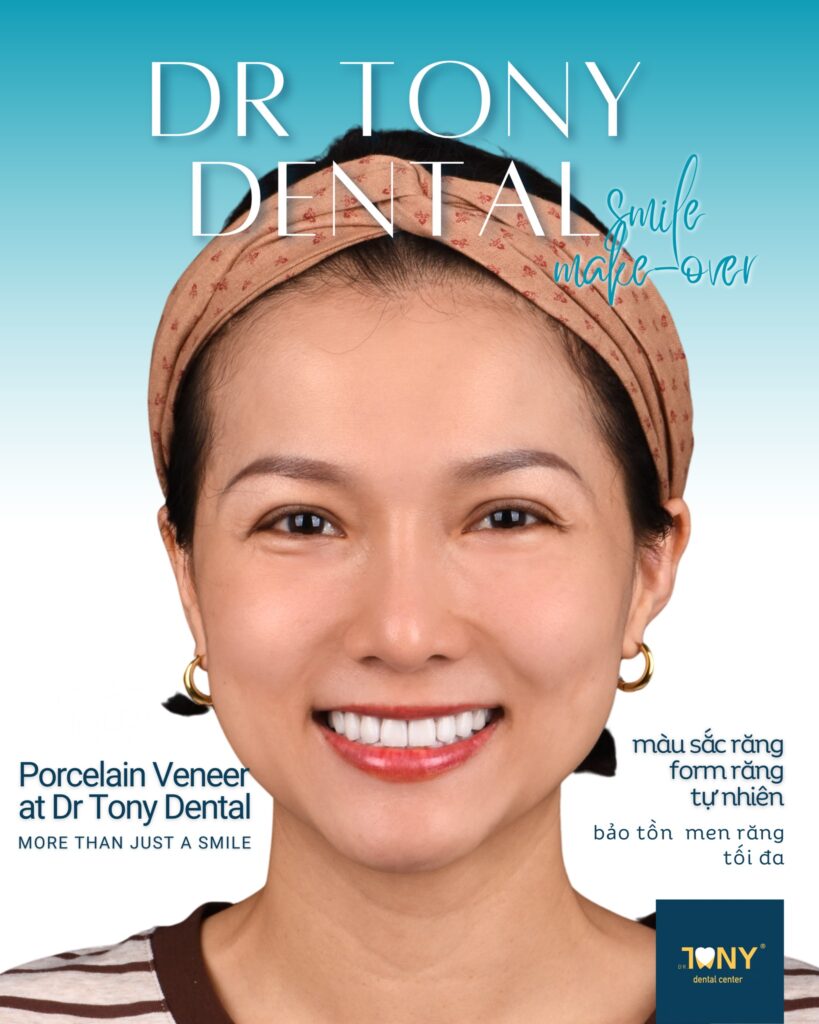
Khai Nguyen Dental Lab is pleased to share a veneer case produced in collaboration with Dr Tony Dental — Veneer and Invisalign Center.

About the clinic

We have had the privilege of working with Dr Ho Le Bao An’s clinic over an extended period. Dr Tony Dental is a leading practice located in central Ho Chi Minh City, known for Invisalign and veneer treatment, and has built a large body of esthetic work with precision and care.

What a long-running clinic partnership changes

Working with the same clinic over time changes what the laboratory can assume. Preparation style becomes predictable, the clinician’s shade preferences are known, and the level of surface texture that suits their patient base is already established. That accumulated context is why a long partnership generally produces fewer remakes than a series of one-off cases — not because the technical work differs, but because fewer things have to be guessed.

Related technical reading: minimum veneer thickness and dental ceramic materials comparison.

Source: Khai Nguyen Dental Lab Facebook page.

Written for dentists and technicians. Khai Nguyen Dental Lab manufactures to clinical prescription only and does not sell directly to patients.

Collaboration with KING’s Dental Specialist Clinic & Imaging Center

KING’s Dental Specialist Clinic & Imaging Center

Khai Nguyen Dental Lab would like to thank Dr Nyan at KING’s Dental Specialist Clinic & Imaging Center for the opportunity to collaborate on a recent restorative case.

What made the case work

Attention to detail, clear communication and consistent support throughout the process are what produced a result beyond expectation. From a laboratory’s perspective those three things are not courtesies — they are the working conditions that determine whether a case needs a second round. A prescription that states what is wanted, photographs that show the substrate, and a clinician who answers a question the same day will together do more for the outcome than any single material choice.

Working with clinics outside Vietnam

Cases sent from abroad cannot be adjusted quickly chairside, so the documentation requirements are tighter rather than looser. What the laboratory needs before starting is set out in dental photography for the laboratory and in our outsourcing FAQ.

We look forward to further collaboration, and to continuing to improve outcomes for patients together.

Source: Khai Nguyen Dental Lab Facebook page.

Written for dentists and technicians. Khai Nguyen Dental Lab manufactures to clinical prescription only and does not sell directly to patients.

Gingivectomy and Full-Arch Veneers with Sunrise Dental Clinic

Cắt nướu & Veneer toàn hàm cùng nha khoa SUNRISE

Khai Nguyen Dental Lab was glad to work alongside Dr Tien and Sunrise Dental Clinic on a gingivectomy and full-arch veneer case for the singer Thanh Thuy.

About the collaboration

Thanh Thuy is a Vietnamese singer who was named Miss Talent at Miss Universe Vietnam 2022 and reached the top 15 at Miss Grand Vietnam. The case combined a gingival contouring procedure carried out by the clinic with a full-arch veneer restoration fabricated at our laboratory.

Why gingivectomy changes the laboratory brief

When gingival contouring precedes a veneer case, the laboratory is working towards a gingival margin that does not yet exist at the time of impression. Two things become critical: the case has to reach the lab with the intended final margin recorded — through the wax-up, the approved mock-up, or clear notes — and the tissue has to be stable before the definitive impression is taken. Fabricating to a margin that is still settling produces an outline that is correct on the model and wrong in the mouth.

The related technical articles cover this from the laboratory side: preparation for crowns and veneers and minimum veneer thickness.

Our thanks

Our thanks to Dr Tien and the team at Sunrise Dental Clinic for the collaboration, and to Thanh Thuy for allowing the case to be shared.

Source: Khai Nguyen Dental Lab Facebook page.

Written for dentists and technicians. Khai Nguyen Dental Lab manufactures to clinical prescription only and does not sell directly to patients.

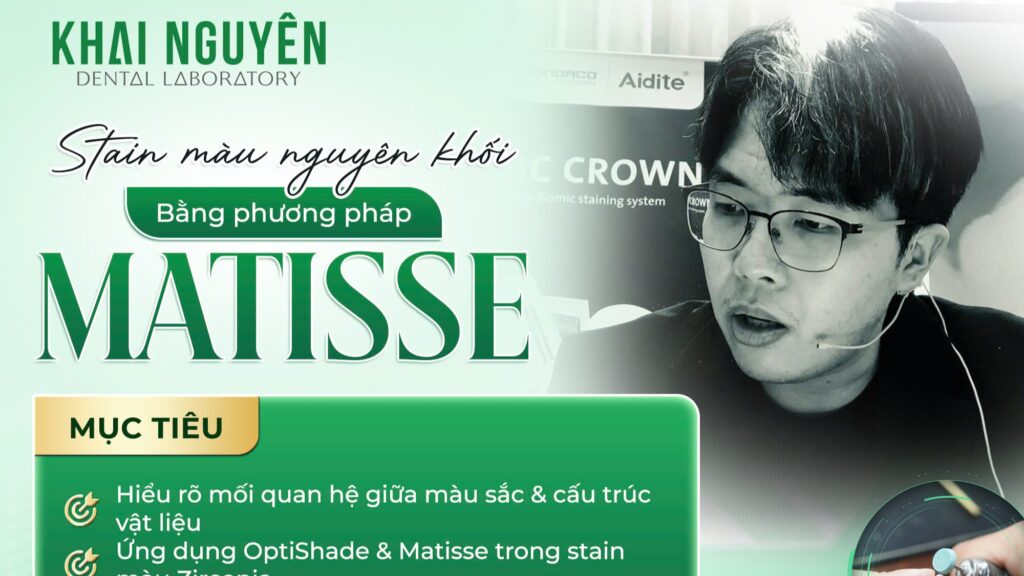
Workshop: Monolithic Staining with the Matisse Method

Workshop: Stain Màu Nguyên Khối Bằng Matisse

On 22 and 23 February 2025, the technicians of Khai Nguyen Dental Lab took part in an intensive workshop on monolithic staining using the Matisse method, held at the laboratory.

Speaker

DT. Ziyang Ke has delivered more than a hundred training courses worldwide, in person and online, and is a leading specialist in esthetic ceramic restorations. A graduate of Taipei Medical University, he has worked at laboratories including Washington Dental Clinic and A Plus 3D, and is currently CEO of Hereisalab.

Programme

  • Understanding and practising shade capture with OptiShade.
  • Applying Matisse technology to shade analysis and stain formulation.
  • Combining a zirconia framework, firing schedule and external staining to reach the most natural esthetic effect.
  • Techniques for building tooth form with the depth and colour reflection of a natural tooth.

Why monolithic staining deserves a dedicated workshop

Monolithic restorations carry no external layering, so everything the eye reads — depth, chroma gradient, incisal translucency — has to be produced by staining and firing on a body that is already fully formed. There is no ceramic build-up in which to correct a misjudged shade. That makes shade capture at the start and stain sequencing during firing the two decisive steps, which is exactly what the Matisse method structures.

Related reading: dental photography for the laboratory, which covers the shade images a laboratory needs before any of this begins.

Source: Khai Nguyen Dental Lab Facebook page, February 2025.

Written for dentists and technicians. Khai Nguyen Dental Lab manufactures to clinical prescription only and does not sell directly to patients.

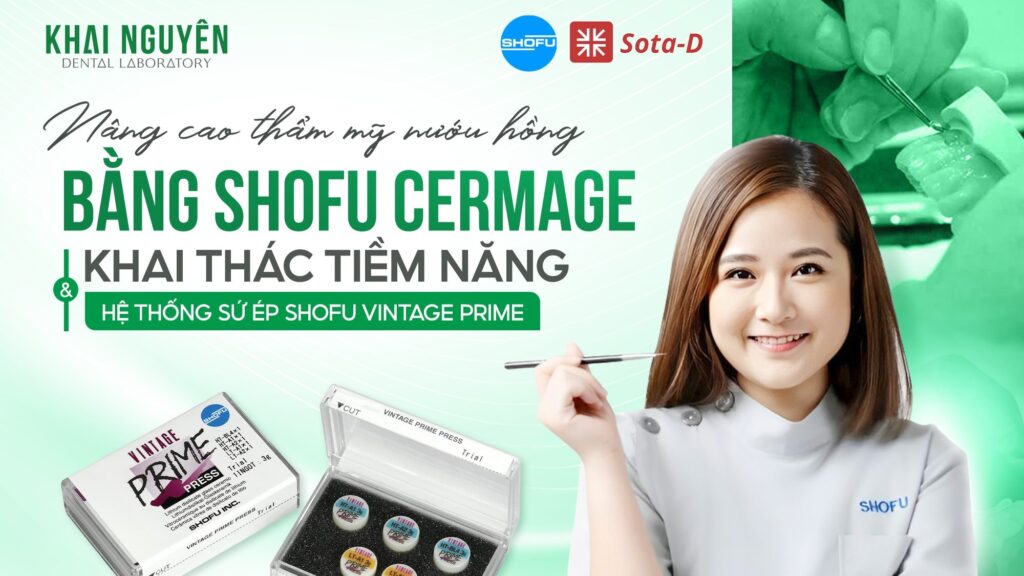
In-House Training with Shofu: Ceramage Pink Gingiva and Vintage Prime Pressed Ceramic

Nâng cao thẩm mỹ nướu hồng bằng Shofu Ceramage & Khai thác hệ thống sứ ép Shofu Vintage Prime

On 26 March 2025, Khai Nguyen Dental Lab hosted an in-house workshop with Shofu (SotaD) on two subjects: building pink gingiva with Ceramage composite, and getting the most out of the Shofu Vintage Prime pressed ceramic system. The session was held for our technicians at the laboratory, from 09:00 to 17:00.

Speaker

Ms Connie Moy qualified as a dental technician in Taiwan. Throughout her career she has focused on practical, high-applicability solutions for modern laboratories — solutions that help a lab meet the clinician’s requirements while reducing repeated adjustments and remakes.

Part 1: pink gingiva with Ceramage composite

The hands-on element covered how to streamline gingival fabrication — shortening working time while holding the esthetic standard — using Ceramage, a composite with 73% ceramic filler. The properties discussed were:

  • Resistance to wear, plaque accumulation and microleakage.
  • A wide shade system that makes natural gingival tones easier to reproduce.
  • A specific fabrication and surface-treatment protocol that improves the durability of the finished work.

This matters most on full-arch implant cases, where artificial gingiva is a large part of the visible result and a large part of the working time.

Part 2: the Shofu Vintage Prime pressed ceramic system

  • A fresh, warm shade register that helps balance esthetics and naturalness.
  • Manufactured in Japan to consistent standards.
  • High flexural strength, reducing chipping.
  • Maximum tooth-structure preservation, with effective resistance to crack propagation.

Why the laboratory invests in this

Working with leading material manufacturers is how a laboratory keeps its technical skill current. Each of these sessions maps onto a specific case type we produce — here, full-arch implant restorations with gingival reconstruction, and pressed ceramic anterior work. Related reading: dental ceramic materials comparison.

Our thanks to Shofu (SotaD) and to Ms Connie Moy for the session and for their support throughout.

Source: Khai Nguyen Dental Lab Facebook page, March 2025.

Written for dentists and technicians. Khai Nguyen Dental Lab manufactures to clinical prescription only and does not sell directly to patients.

“A Thousand and One Questions from the Lab”: Episode Index

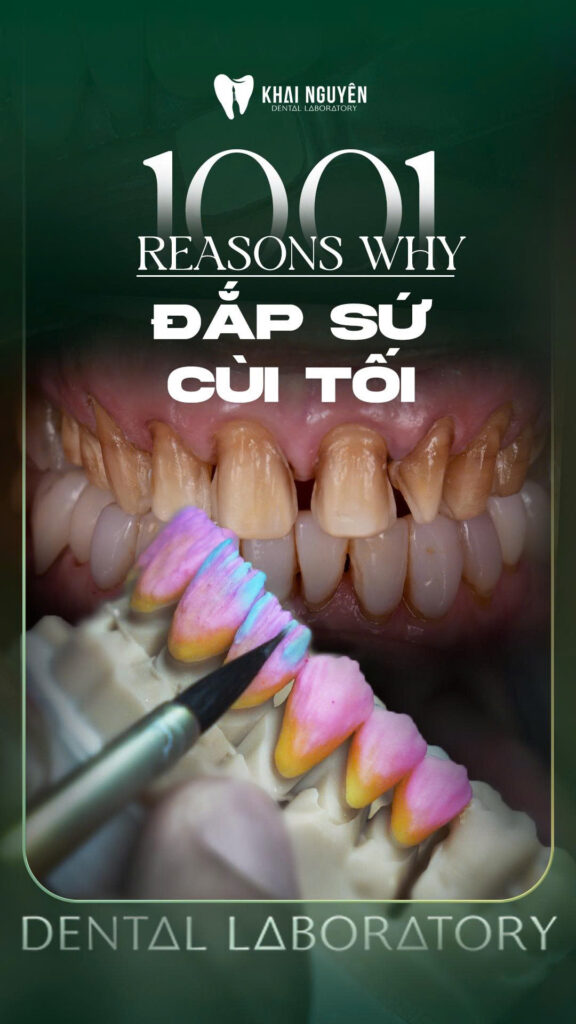
Series 1001 câu hỏi vì sao tại labo, tập 2: bí kíp xử lý ca cùi tối màu, đắp sứ trên sườn

The series “A Thousand and One Questions from the Lab” is a run of short videos produced by the technicians at Khai Nguyen Dental Lab since May 2026, answering the professional questions that come up daily at the bench. It began as a way for our own technicians to revise together and share practical experience, and to support technicians new to the trade. This page collects the episodes released so far and the technical content behind each.

Above: the series, episode 2 — handling a dark preparation.

Episode 1: how polishing differs from glaze firing

Released 26 May 2026. This is the question new technicians ask most often at the finishing stage. Glaze firing applies a thin glassy layer and fires it, giving a very high shine but softening the surface texture, and it can wear away over time. Mechanical polishing creates the shine within the ceramic body itself, preserves the surface texture the technician created, and can be restored after the clinician makes an occlusal adjustment.

Episode 2: handling a dark preparation

Released 2 July 2026. How to mask a dark preparation while still reaching a bright shade and keeping natural translucency. The episode covers what the technician actually does at the framework and layering stages: choosing an ingot of the right opacity, cutting back to leave room for the effect layer, and placing the masking layer against the preparation rather than thickening the whole restoration evenly.

Episode 3: what makes a single dark-preparation central incisor more manageable

Released 14 August 2026. A single anterior unit on a dark preparation is always a demanding brief. This episode sets out three core factors the clinician can prepare so that the success rate is higher: restorative space, material, and a design matched to the required effect.

Related articles on the site

Suggest a topic

The series is built from real questions. If you have one you would like the laboratory to answer in a coming episode, send it through our contact channels or comment under the videos on the Khai Nguyen Dental Lab Facebook page.

Source: Khai Nguyen Dental Lab Facebook page, videos of 26 May, 2 July and 14 August 2026.

Written for dentists and technicians. Khai Nguyen Dental Lab manufactures to clinical prescription only and does not sell directly to patients.


WhatsApp