

Case fabricated at Khai Nguyen Dental Lab to the treating dentist’s prescription, published on Instagram @khainguyendentallab on 20 June 2025. No patient-identifying information is included.
Case summary
| Indication | Twelve-unit restoration: zirconia bridge and crowns |
|---|---|
| Material | IPS e.max ZirCAD Prime |
| Shade | A3 to A3.5 |
| Technical focus | Uniform form, shade and surface texture across twelve units |
| Photo source | Instagram @khainguyendentallab, 20 June 2025 |
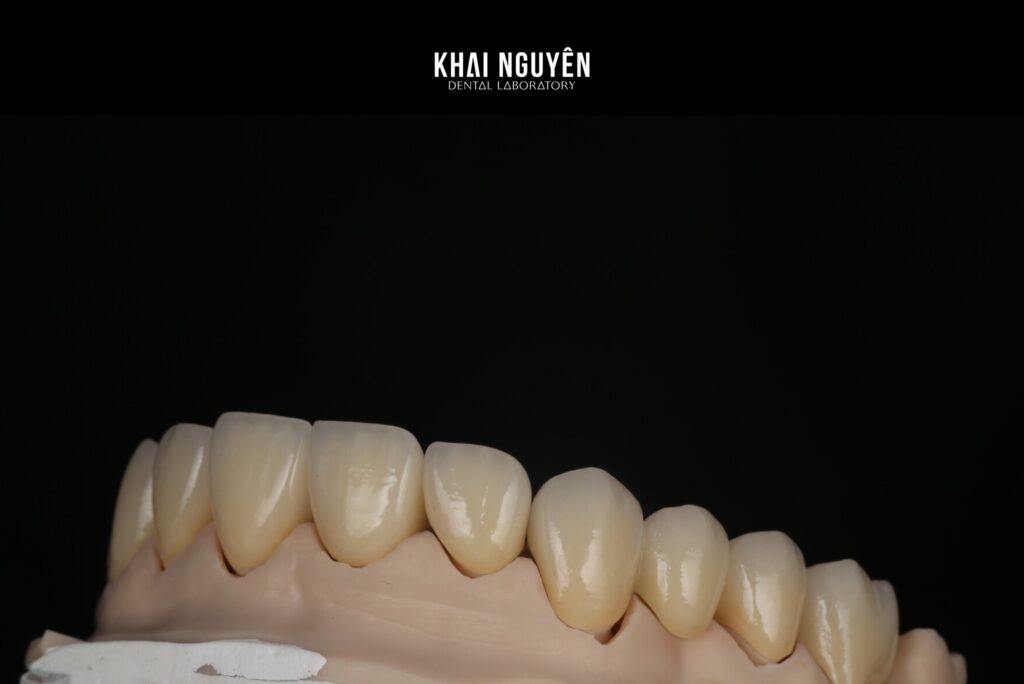
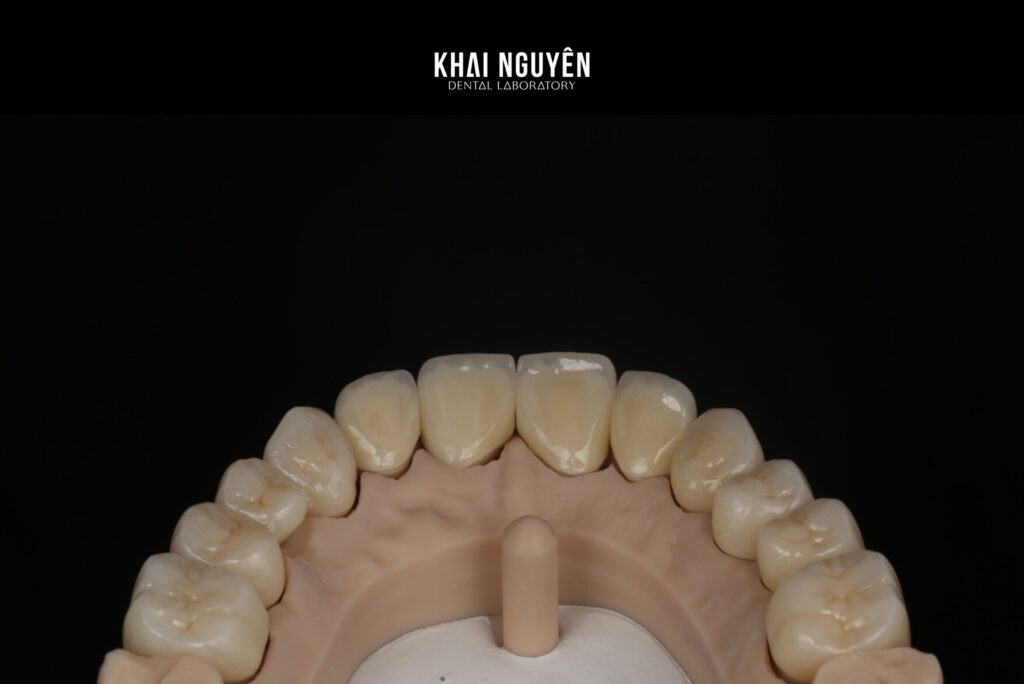
Photo above: twelve zirconia bridge and crown units in shade A3 to A3.5 on the model, frontal view.
Why twelve units is harder than twelve times one unit
A single crown slightly off-tone against natural teeth is usually acceptable. In twelve adjacent units the eye compares the restorations with each other rather than with natural teeth, so any unit differing in gloss, translucency or form shows immediately. A long case also demands occlusal control across the whole arch and adequate connector cross-sections at the pontics.
Shade A3 to A3.5 is a warm range, common in middle-aged patients, and is not as forgiving as bleach shades: each tooth needs a gradient from a warm cervical zone to a translucent edge while the arch as a whole must not read as too yellow.
How the lab keeps twelve units consistent
- One design file for the whole case. Each tooth is built in relation to the others, never designed as separate crowns and merged later.
- Controlled disc nesting. With a multilayer ZirCAD Prime disc, the position of each unit inside the disc decides whether the cervical zone sits in the opaque layer and the incisal edge in the translucent one. Wrong nesting is a common reason a few units come out off-tone.
- Sinter in one batch so all units go through the same thermal cycle.
- Stain by arch, not by tooth. All twelve units are placed on the model and stained together, checked under neutral light after each firing.
- Static and excursive occlusion checked on the articulator before the surface is finished.
Lessons for multi-unit cases
- Send a reliable bite record and facial photos. A twelve-unit case redefines the whole smile, so the lab needs references from the face, not only from the model.
- State the shade range explicitly, for example A3 cervically and A3.5 on the body, if you want the gradient to run a specific way.
- Consider a framework try-in for cases with long pontic spans, to check fit and occlusion before staining.
See also choosing zirconia discs by case and the three-unit zirconia bridge 11 to 13. WhatsApp +84 902 945 585.
Another full-arch zirconia case: full zirconia for a bruxing patient.
Written for dentists and technicians. Khai Nguyen Dental Lab manufactures to clinical prescription only and does not sell directly to patients.