


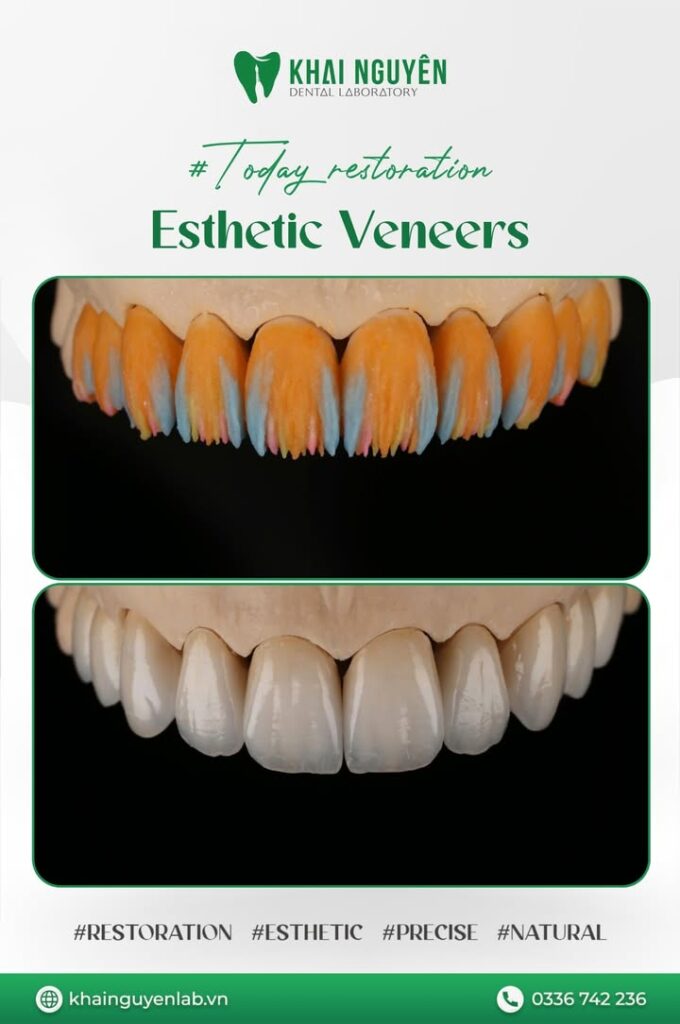
A GC LiSi Press veneer case recently completed at Khai Nguyen. This note records the sequence of steps behind it.
Four stages that decide the result
Adjusting the coping for fit. Before shade enters the conversation, the restoration has to seat correctly on the preparation. This is settled at the framework stage, because any discrepancy left afterwards gets covered by ceramic and can no longer be corrected.
Hand layering. LiSi Press provides a good translucent base, but the shade transition and the liveliness of the incisal edge still have to be placed layer by layer by the technician.
Shaping the form. Form decides whether a veneer looks natural more than shade does. Length, outline, facial convexity and contact point position all have to suit the patient’s face and smile line.
Creating surface texture. Natural teeth are not flat. Fine horizontal ripples and vertical grooves scatter light instead of reflecting it as one bright patch. Skip this and the veneer will be evenly coloured yet still read as artificial.
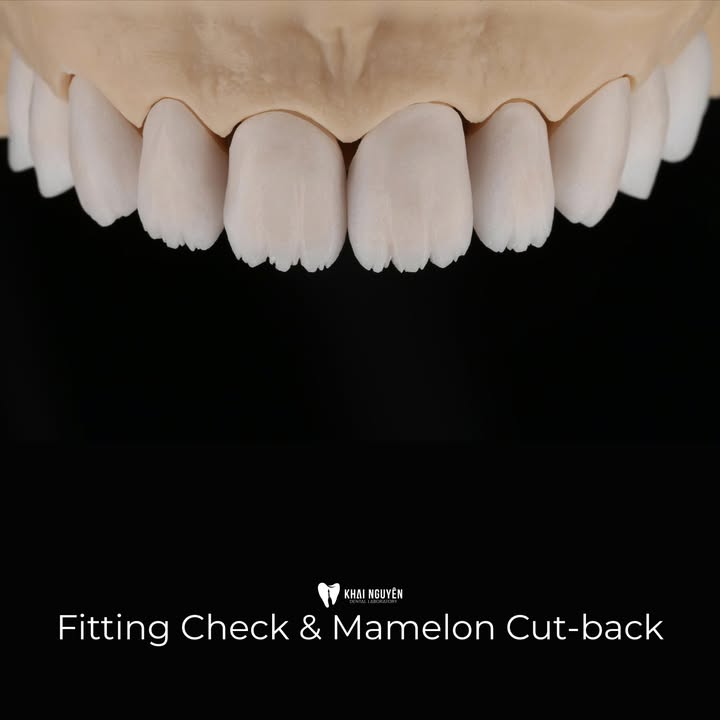
What this shows
None of the four stages rescues a mistake from the one before it. A coping that does not seat makes good shade irrelevant; wrong form cannot be saved by texture. That is why the lab checks at each stage rather than only inspecting the finished unit.
What clinicians can use from this
On a high-esthetic case, ask the lab for photographs at the framework stage or before glazing. A few minutes reviewing an image then is far cheaper than one remake.
See GC LiSi Press, or our ceramic materials comparison.
Written for dentists and technicians. Khai Nguyen Dental Lab manufactures to clinical prescription only and does not sell directly to patients.