Category Archives: Outsourcing Guides

How to evaluate and work with a Vietnam dental laboratory: pricing, turnaround, quality certification, shipping and case submission. Guides for dentists and labs in the US, Australia and Europe considering outsourcing to Khai Nguyen Dental Lab.
Full-Mouth Rehabilitation Combining Veneers, Onlays, Crowns and Implants: Occlusion Control and Shade Consistency

Ca nâng khớp toàn hàm phối hợp veneer, mão sứ và phục hình trên implant, Khai Nguyên Dental Lab

Written for dentists and dental technicians, based on three full-mouth rehabilitation cases Khai Nguyen Dental Lab published on Facebook between January and April 2026, fabricated to the prescriptions of the treating dentists (including Dr Sai Aom Kham and Dr Nguyen Ngoc Trung Hau of Vien Dong Dental Clinic). Photos were taken by the lab; no patient-identifying information is included.

A full-mouth rehabilitation with an increase in vertical dimension rarely uses one type of restoration. Anterior teeth need veneers or esthetic crowns, worn posterior teeth need onlays or crowns, edentulous areas need implant restorations, and all of them must occlude at a new vertical dimension in one uniform shade. For the lab the challenge is not any single unit but two things that run through the whole case: occlusion, and shade consistency across different materials. This article summarises how Khai Nguyen organises such cases.

Two challenges of mixed-restoration cases

Controlling occlusion at a new vertical dimension

When the bite is raised there is no natural tooth left as a reference for the occlusal plane and excursive guidance. The lab rebuilds everything on the articulator at the vertical dimension, centric relation and canine guidance the dentist established with the provisionals. The provisional the patient has worn comfortably for several weeks is therefore the most valuable data: a scan of it gives the lab an occlusal plane, incisal edge length and amount of opening that have been tested in the mouth, instead of designing from scratch.

Shade consistency across veneers, onlays, crowns and implants

Each restoration type sits on a different substrate: veneers on bright enamel, crowns on darker stumps, onlays on dentin, implant crowns on titanium or zirconia abutments. The same shade code on the prescription gives four different results if the lab uses one opacity for all. The solution is to select the opacity of the core individually per unit according to its substrate, while using one porcelain system for the outer layer across the whole arch so translucency and surface texture are uniform.

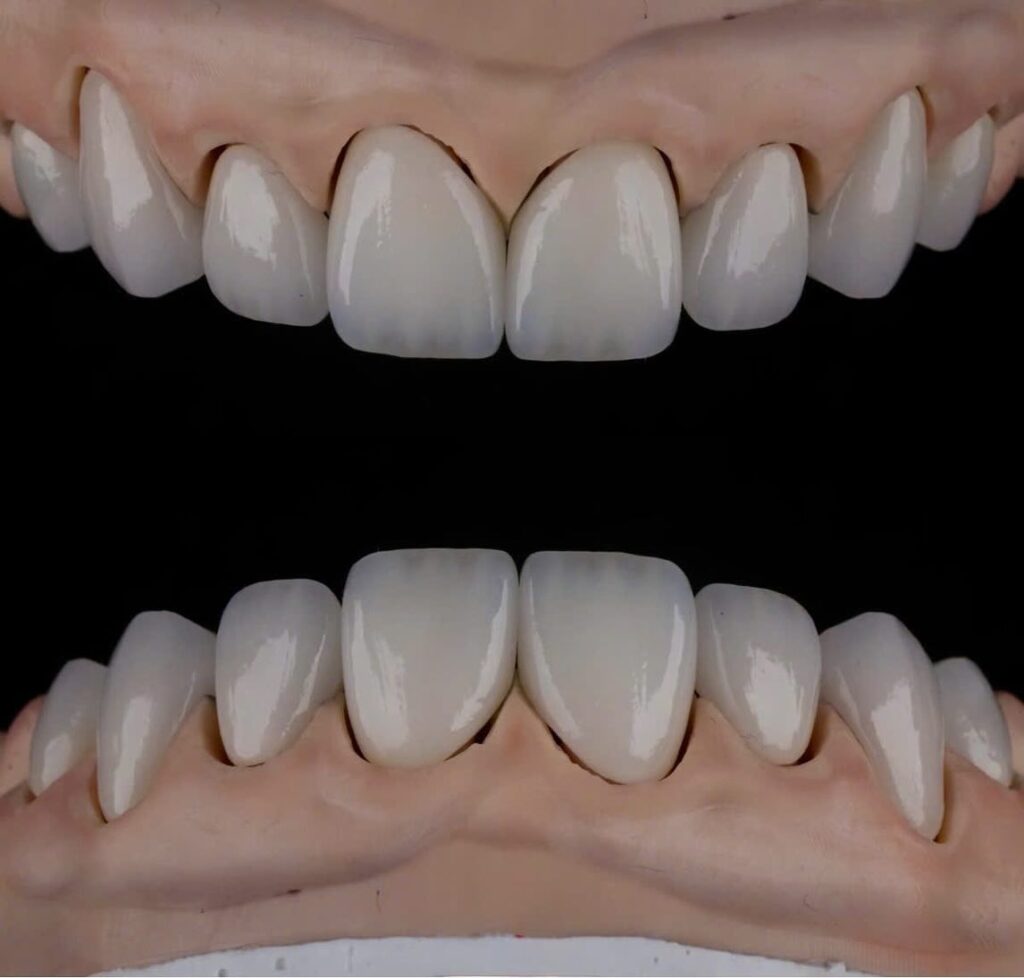
Photo above: Full-mouth rehabilitation combining veneers, ceramic crowns and implant restorations: occlusion and overall esthetics are planned together for every unit.

Lab workflow

  1. Complete data set: scans of both arches after preparation, a scan of the stabilised provisional, a bite record at the new vertical dimension, frontal and lateral smiling facial photos, a shade photo with the tab in frame, the stump shade of each tooth and the abutment type of each implant.
  2. Design the whole arch in one file. The lab designs upper and lower arches together: occlusal plane, midline, lip support, canine guidance, and only then separates the units by restoration type. Separating too early is the source of most occlusal errors in large cases.
  3. Material by position and substrate: for example pressed or feldspathic veneers for the anterior teeth, multilayer zirconia for posterior and implant crowns, lithium disilicate for onlays. In the ZirCAD Prime case, the disc’s Gradient Technology provides a smooth shade transition inside the block, which helps zirconia crowns blend with the layered veneers next to them.
  4. Produce in groups and try everything on the articulator. Cores and crowns are tried together on the model to check contacts, static and excursive occlusion before the outer porcelain is layered.
  5. Layer and finish a uniform outer layer on every unit with the same porcelain system and firing schedule; check shade under several light sources and photograph the whole case before shipping.

Illustrative case: full arch in ZirCAD Prime with Gradient shading

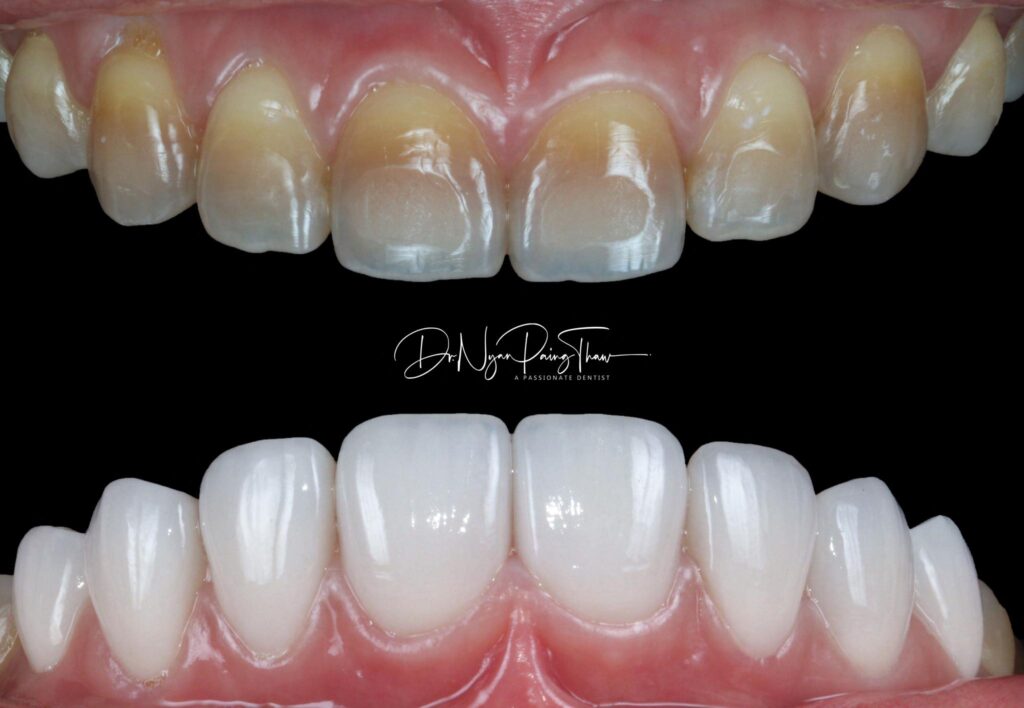
In a case prescribed by Dr Nguyen Ngoc Trung Hau (Vien Dong Dental Clinic), IPS e.max ZirCAD Prime was chosen for most units because of the high esthetic demand across the arch. The gradient built into the disc gives posterior and anterior crowns the same colour family without relying entirely on hand layering, while the incisors were cut back and layered for translucency and effects. Coordination between clinic and lab, from provisional to framework try-in, decided this case.

What the dentist should prepare before sending a full-mouth case

  • A stabilised provisional worn for at least 4 to 8 weeks at the new vertical dimension, with its scan sent with the case.
  • A reliable bite record at that vertical dimension; if in doubt send two and say which takes priority.
  • A per-tooth material plan agreed between dentist and lab before preparation, because reduction differs between veneers, onlays and crowns.
  • Stump shade photos for every tooth and the implant abutment types, so the lab sets the core opacity per unit.
  • A try-in plan: a full-mouth case should have at least one framework or tooth try-in before finishing, even in a digital workflow.

Read more: zirconia crowns and veneers over uneven preparation shades, how to choose a lab for large cases. Send a full-mouth case via WhatsApp +84 902 945 585.

How to Choose a Dental Lab: a 10-Point Checklist for Clinics Before You Commit

Working With a Vietnam Dental Laboratory: A Guide for US & Australian Dentists

Disclosure: this guide is written by Khai Nguyen Dental Lab, a ceramic laboratory in Ho Chi Minh City, Vietnam. We benefit when dentists choose us, so every criterion below is framed as something a clinic can verify independently with any laboratory, not only ours. The section about Khai Nguyen is at the end.

Choosing a dental laboratory directly affects your remake rate, chair time and your reputation with patients. The unit price is only part of the real cost: a lab that is 30% cheaper but doubles your remakes saves you nothing and costs you an extra appointment per failed unit. Below are ten criteria for evaluating a lab, whether it is across town or overseas, each with a way to check it and a question to ask before you send the first case.

1. A certified quality management system, with a certificate you can verify

Why it matters: a dental restoration is a custom-made medical device. ISO 13485 is the quality-management standard written specifically for medical-device manufacturers: documented work instructions, calibrated equipment, recorded complaints and corrective actions. An ISO 13485 certificate does not guarantee every unit will be beautiful, but it does mean defects are traced and corrected systematically instead of case by case.

How to check: ask for the certificate showing the number, the certification body and the expiry date, then look it up on the certification body’s register. For labs outside your country, ask which national medical-device registrations they hold; in Vietnam, for example, the Ministry of Health issues a Certificate of Free Sale for restorations. If you are comparing offshore options, read our country-by-country comparison of dental lab outsourcing.

Question to ask: “Can I see your current ISO 13485 certificate and any medical-device registration for your restorations?”

2. Brand-name materials, named on the delivery note and traceable by lot

Why it matters: “zirconia” and “pressed ceramic” are material classes, not products. A 3Y-TZP disc from a major manufacturer is rated around 1,200–1,300 MPa and backed by clinical data; a disc of unknown origin has no one standing behind it when it fractures. You need to know whether your case was made from 3M Lava Esthetic, IPS e.max, Cercon or DD Bio so you can prescribe correctly and tell the patient what is in their mouth.

How to check: the delivery note should state the brand and the material lot number. Ask whether the lab has a formal relationship with the manufacturer (Ivoclar’s Lab Partner programme, authorised 3M or Dentsply Sirona distribution). Our comparison of zirconia, lithium disilicate and feldspathic ceramics shows which class suits which indication.

Question to ask: “Which brand and lot number was used for this case, and can you show a purchase record from an authorised distributor?”

3. A clear digital workflow that is compatible with your scanner

Why it matters: most fit and contact problems start with the input data. The lab must accept STL, PLY or DCM files from iTero, 3Shape TRIOS, Medit, Primescan and other scanners, and must tell you immediately when a scan is missing the bite or the margin is unclear, rather than quietly guessing and shipping a unit that does not fit.

How to check: send one test scan and time the response. Ask whether you get a design preview (screenshots or a 3D viewer link) to approve before milling. Our guide to intraoral scanner compatibility and file formats lists what to include with each export.

Question to ask: “Which scanners and file formats do you accept, which CAD software do you design in, and can I approve the design before production?”

4. In-house production equipment, with no critical step subcontracted

Why it matters: a lab that sends your milling or pressing to another lab controls neither the schedule nor the quality. The CAD/CAM mill, zirconia sintering furnace, press furnace, porcelain furnace and ceramic layering room should be under one roof, so that every step has a named person responsible for it.

How to check: visit the lab, or ask for a video of the actual production floor. Ask for the make of the mill and sintering furnace and how often they are calibrated. As an example of what to look for, see the porcelain furnace and CAD/CAM equipment we describe on our site.

Question to ask: “Which steps are done on your premises, and which are sent elsewhere?”

5. Named technicians with real expertise and ongoing training

Why it matters: with the same materials and machines, the difference between two labs is the technician, especially in layering, shade work and occlusal control. A serious lab will tell you who is working on your case and let you talk to them when needed.

How to check: ask whether the lab runs internal training or invites external clinicians and ceramists, and how many years of experience the technician assigned to your esthetic cases has. Our news and events section lists some of the workshops we have hosted, including one on digital impressions and material selection.

Question to ask: “Who is the technician responsible for my anterior cases, and how do I contact them directly?”

6. Turnaround times committed in writing, and met

Why it matters: you book the patient’s next appointment around the promised delivery date. A lab that is one day late costs you one appointment and some of the patient’s trust. Turnaround should be stated per restoration type (a monolithic zirconia crown is not a layered anterior bridge), not as a single number, and for overseas labs it should be split into in-lab time and courier time.

How to check: ask for a turnaround table by restoration type and track on-time delivery over your first ten cases. At Khai Nguyen, standard digital cases take 1.5–3 working days in the lab, layered esthetic work takes longer, and DHL Express delivers to most countries in 3–4 days. Details are in our article on turnaround time and shipping from a Vietnam dental lab.

Question to ask: “What is the turnaround for a zirconia crown, an e.max crown, a layered veneer and an implant bridge, and what happens when you miss a date?”

7. A clear warranty and remake policy, with a warranty card per restoration

Why it matters: restorations can fracture, debond or discolour. What you need to know in advance is who pays for the remake, for how long, and what is excluded. A warranty tiered by material (for example six months for removable appliances and up to fifteen years for zirconia) is more credible than one blanket figure for everything.

How to check: read the warranty policy published on the lab’s website and look for the warranty card that ships with the case. You can use Khai Nguyen’s ordering, shipping, payment and warranty policies as a reference when comparing.

Question to ask: “How long is the warranty for each material, what is excluded, and who pays the shipping on a remake?”

8. Reliable shipping and controlled packaging

Why it matters: thin ceramic restorations break in transit, and a case mixed up between two clinics is an unacceptable error. The lab needs a sealing and labelling procedure, a photograph of every case before it ships, and, for international work, a tracked express courier with a known transit time.

How to check: ask which courier is used, whether shipments are tracked, whether the lab handles the export declaration, and whether you receive case photos before delivery for comparison on arrival. Our four-step ordering process describes how we do this.

Question to ask: “How are cases packed and shipped, and who is responsible if a unit is damaged in transit?”

9. Remake rates that are recorded and shared openly

Why it matters: the real cost of a lab is unit price multiplied by (1 + remake rate) plus your chair time. A good lab tracks remakes per dentist and works with you to find the cause (scan, preparation, design or production) instead of trading blame.

How to check: after your first 10–20 cases, ask the lab for a summary of remakes and their reasons. A lab that has no such data is a lab without a system.

Question to ask: “What is your average remake rate, and how do you record the cause of each remake?”

10. Transparent pricing from a published list, with no surprises on difficult cases

Why it matters: an unusually low price usually means unbranded material or a skipped inspection step. What you need is a price list by material and complexity (monolithic, cut-back and layered, fully layered), with the rush-case surcharge stated up front.

How to check: compare the price lists of two or three labs on the same brand-name material, never on “zirconia” in general. Run two or three identical trial cases at each lab before signing anything. Our article on what to expect to pay a Vietnam dental lab explains how offshore pricing is structured.

Question to ask: “Can I have your price list by material and complexity, what is your payment cycle, and what is the surcharge for rush cases?”

Download the checklist

Download the 10-point dental lab evaluation checklist (PDF) and use it with any laboratory you are considering. Each criterion has a tick box and space to record the lab’s answer.

How Khai Nguyen Dental Lab measures up

  • Certification: quality management system certified to ISO 13485:2016 (certificate No. 9199293420717-MED, ISOCERT); restorations hold Certificates of Free Sale issued by the Vietnam Ministry of Health in June 2025. See our outsourcing overview for the full quality system.
  • Materials: brand-name discs and ingots only, from 3M, Ivoclar Vivadent, Dentsply Sirona, GC, Shofu and Dental Direkt, with lot traceability; Ivoclar Lab Partner and official Invisalign partner.
  • Digital workflow: open STL, PLY and DCM from any common scanner, design in exocad, design preview on request before production.
  • In-house equipment: CAD/CAM milling, sintering, pressing and a hand-layering ceramic department at one site in Ho Chi Minh City.
  • Technicians: a team trained by experienced clinicians, with regular workshops led by local and international specialists.
  • Turnaround: 1.5–3 working days in the lab for standard digital cases; DHL Express delivery in 3–4 days with tracking.
  • Warranty: 6 months to 15 years depending on material, with a warranty card for every case.

Want to test us before you commit? Send two or three trial cases through our contact page or WhatsApp +84 902 945 585, and we will review the results with you against these ten criteria. If you have more questions first, see the outsourcing FAQ.

Outsourcing Dental Lab Work: Vietnam vs China vs India

How to Outsource Dental Lab Work to Vietnam: Complete 2026 Guide

Disclosure: this comparison is written by Khai Nguyen Dental Lab, a laboratory in Vietnam. We have an obvious interest in the outcome, so we have kept the comparison to factors you can verify yourself and avoided claims about individual competitors.

TL;DR: China, India and Vietnam are the three main destinations for outsourced dental lab work. China offers the largest capacity and lowest unit prices on high-volume monolithic work; India offers English-language communication and a growing digital-lab sector; Vietnam sits between them on price with a strong esthetic ceramics tradition, ISO 13485-certified mid-sized labs, and 3–4 day courier links to the US and Australia. The right choice depends on your case mix, not on the country’s reputation.

Why these three countries

All three have a large trained technician workforce, access to the same brand-name materials (3M, Ivoclar Vivadent, Dentsply Sirona, GC, Shofu), CAD/CAM infrastructure and express-courier links to North America, Australia and Europe. The differences are in scale, specialisation, language, regulation and logistics.

Comparison by factor

Factor China India Vietnam
Typical lab profile Very large factories, thousands of technicians, highly automated monolithic production Mix of large export labs and mid-sized digital labs, strong in CAD design services Mid-sized labs with in-house ceramic departments; a few very large volume labs
Best suited for High-volume monolithic zirconia, removables, price-driven contracts Design outsourcing, English-heavy communication, mixed case types Esthetic fixed restorations (layered zirconia, e.max, feldspathic veneers), implant work, lab-to-lab overflow
Unit price (same material) Lowest at volume Low to medium Low to medium; between China and India for esthetic layered work
Language Sales teams in English; technician-level communication often through an intermediary English widely spoken at all levels English at coordinator and management level; technicians communicate through case notes and photos
Quality systems ISO 13485 common in export labs; FDA-registered facilities exist ISO 13485 common in export labs ISO 13485 in export-oriented labs; Ministry of Health Certificates of Free Sale for restorations
Courier transit to US/AU 3–5 days 4–6 days 3–4 days (DHL Express from Ho Chi Minh City)
Time zone vs US East +12/13 h +9.5/10.5 h +11/12 h
Public holidays to plan around Chinese New Year (1–2 weeks), Golden Week Diwali, regional holidays Tết (about a week, late January or February)
Main risk Anonymous production: hard to reach the technician who made your case Wide quality variance between labs; longer shipping Smaller capacity: not the place for tens of thousands of units per month

What the price difference actually buys

Skilled technician labour costs less in all three countries than in the US, Australia or Western Europe, which is the whole reason outsourcing exists. Within the three, China’s scale gives it the lowest unit price on standardised monolithic work. Vietnam and India are close to each other; Vietnam’s edge is in hand-finished esthetic work, where the ceramist’s hours dominate the cost and the country’s tradition of layered porcelain shows. Whatever the country, the real cost is unit price multiplied by remake rate plus your chair time. A lab that saves you 40% per unit but doubles your remakes saves you nothing; read our breakdown of what dentists should expect to pay a Vietnam dental lab.

Quality: material is identical, process is not

A zirconia disc from Dentsply Sirona or a lithium disilicate ingot from Ivoclar is the same in Shenzhen, Chennai or Ho Chi Minh City. What differs is the process around it: design review, sintering-furnace calibration, shade matching under controlled light, occlusal verification on articulated models, and whether a named technician follows your case. Ask any lab in any country for its ISO 13485 certificate, its material invoices, its remake statistics and the name of the technician assigned to your esthetic cases. The answers separate good labs from cheap ones better than the country of origin does.

Communication and time zones

India’s English advantage is real at the technician level. Chinese factories usually route communication through account managers. Vietnamese labs typically have English-speaking coordinators and rely on structured case notes, photos and design previews for technical detail; in practice this works well because most technical communication in dentistry is visual. All three countries are far enough ahead of US time zones that an evening question is answered by the next morning. Australia has the easiest overlap with Vietnam (3–4 hours difference).

Logistics and regulation

Express couriers connect all three countries to the main markets. From Ho Chi Minh City, DHL Express reaches most US, Australian and European destinations in 3–4 days; China is similar, India usually a day or two longer. Custom-made dental restorations are prescribed medical devices and travel with a commercial invoice; clinics should confirm their own country’s import rules for custom devices (for example FDA registration expectations in the US or TGA rules in Australia) and ask the lab which documentation it provides. Vietnam-made restorations from certified labs carry Ministry of Health Certificates of Free Sale.

A practical way to decide

  1. Write down your monthly case mix: how many monolithic units, how many esthetic layered units, how many implant cases.
  2. If monolithic volume dominates and price is the goal, shortlist Chinese and large Vietnamese labs.
  3. If esthetic and implant work dominate, shortlist Vietnamese mid-sized labs and specialised Indian labs.
  4. If you mainly need design services, India and Vietnam both offer next-day CAD.
  5. Run the same 2–3 cases with two labs and compare fit, shade, communication and remake handling before signing anything.

For a comparison within Vietnam, read our honest comparison of the best-known dental labs in Vietnam, and for the full workflow see outsourcing to a Vietnam dental laboratory. Questions about your specific case mix: WhatsApp +84 902 945 585.

Vietnam Dental Lab Turnaround Time and Shipping: What to Expect

How to Outsource Dental Lab Work to Vietnam: Complete 2026 Guide

TL;DR: a Vietnam dental lab typically needs 1.5–3 working days in the lab for a standard digital case, and DHL Express delivers to the US, Australia or Europe in 3–4 days. Realistic door-to-door time for a physical restoration is therefore 6–9 days from the moment the scan is uploaded; digital-only design work comes back the same or next working day. This article explains where the days go, how to compress them, and how to plan patient appointments around an overseas lab.

Where the days go: the four clocks

Turnaround from an overseas lab is not one number but four separate clocks that run one after the other.

  1. Submission and confirmation (0–1 day). The scan is uploaded with the prescription. A good lab confirms the case, flags missing bite scans or unclear margins, and agrees the due date within its next working shift. Vietnam is GMT+7, so a case sent from the US East Coast in the evening is on a technician’s screen before you wake up.
  2. In-lab production (1.5–5 working days). Design in exocad, milling or pressing, sintering, staining or layering, glazing and quality control. Monolithic zirconia is fastest; layered anterior work and implant bridges take longest.
  3. Shipping (3–4 days by DHL Express). Ho Chi Minh City to most US, Australian and European cities. Customs clearance is handled by the courier; delays are rare but possible around public holidays.
  4. Chairside (your clock). Try-in, adjustment, cementation. Cases with a design preview approved by you before production need fewer chairside adjustments.

Turnaround by restoration type at Khai Nguyen Dental Lab

Restoration In-lab working days Door to door (with DHL)
Monolithic zirconia crown or bridge 1.5–3 about 6–8 days
Lithium disilicate crown, inlay, onlay 2–3 about 6–8 days
Layered or cut-back esthetic crowns, veneers 3–5 about 8–10 days
Implant crowns and bridges 3–5 about 8–10 days
Full-arch implant prostheses, wax-ups, surgical guides agreed per case agreed per case
CAD design only (lab-to-lab) same or next day digital delivery

Working hours are 08:00–17:30 Indochina Time, Monday to Sunday. Cases received on Vietnamese public holidays (Tết in late January or February is the longest, about a week) are confirmed on the next working day, so ask your lab for its holiday calendar at the start of the year.

Shipping: what to expect from DHL Express

Restorations ship in sealed, padded case boxes with the case photos and prescription copy inside. Each shipment has a tracking number sent to you on dispatch. Transit from Ho Chi Minh City is typically 3–4 days to the US and Australia and 3–4 days to Western Europe. Import formalities for custom-made dental devices are normally handled by the courier; your lab should provide a commercial invoice and, where the destination requires it, a Certificate of Free Sale. Shipping cost per parcel is the same whether it holds one crown or twenty, so clinics with regular volume batch cases into a weekly or twice-weekly shipment.

Physical impressions travelling to Vietnam add 3–4 days before the lab clock starts. This is the single biggest reason to move to an intraoral scanner if you plan to outsource: a digital case starts production the same day it is scanned.

How to compress the timeline

  • Scan instead of ship. STL, PLY or DCM files start production immediately; impressions lose 3–4 days in transit.
  • Send complete data the first time. Bite scan, pre-op scan for esthetic cases, shade photos with a tab, implant system and scan body. Every clarification email costs a working day because of the time difference.
  • Approve a design preview. Ten minutes reviewing contacts and contour before production saves a remake cycle of a week or more.
  • Batch shipments. Agree a fixed dispatch day; cases finished earlier wait one or two days but arrive together and cheaper.
  • Keep a domestic lab for true emergencies. An overseas lab is the right choice for planned work, not for a same-day temporary.

Planning appointments around an overseas lab

Book the delivery appointment 10 working days after the scan for standard crowns and 12–14 days for esthetic or implant cases. That leaves a buffer for a customs delay or a design revision without moving the patient. If your lab reports the shipment tracking number on dispatch, your front desk can confirm the appointment two days before delivery with confidence. Clinics working with us in the US and Australia typically settle on a weekly rhythm: scans go out Monday to Wednesday, cases ship the following week, and delivery appointments are booked the week after.

What “rush” really means

In-lab time can be shortened for digital monolithic work when you tell us the deadline at submission, but shipping cannot be shortened below courier transit. A realistic rush for a zirconia crown is about five days door to door; anything faster requires a domestic lab. Be wary of any overseas lab quoting two- or three-day delivery for physical restorations.

Frequently asked questions

Does the time difference slow communication?

It helps more than it hurts. Vietnam is 11–15 hours ahead of US time zones and 3–4 hours behind eastern Australia, so questions sent at the end of your day are answered by the start of your next one. For urgent clarifications we use WhatsApp during overlapping hours.

What if a case is delayed?

The lab should tell you before the due date, not after. At Khai Nguyen every case has a due date agreed at confirmation, and any change is communicated with a new date and the reason.

Can I track the case inside the lab?

Yes. Status updates are sent at confirmation, at design preview (if requested), at dispatch with the tracking number, and on delivery.

Ready to test the timeline with a real case? Read the ordering process, the outsourcing FAQ, or contact us on WhatsApp +84 902 945 585. For the bigger picture, see our guide to outsourcing to a Vietnam dental laboratory.

Best Dental Labs in Vietnam (2026): An Honest Comparison

Best Dental Labs in Vietnam (2026): An Honest Comparison

Disclosure: this guide is published by Khai Nguyen Dental Lab, one of the laboratories listed below. To keep it useful, we compare every lab — including ourselves — on the same publicly verifiable criteria, and we tell you honestly which lab fits which need. Information about other laboratories comes from their public websites as of July 2026; always verify details directly with each lab.

TL;DR: Vietnam has become one of the strongest dental outsourcing destinations in Asia. The best-known dental labs in Vietnam include Khai Nguyen Dental Lab (esthetic fixed restorations, ISO 13485:2016), Lavina (largest production scale), XDENT Lab (removables), Vietnam Dental Lab (operating since 2008), and Thanh Dental Laboratory (since 1999). The right choice depends on what you outsource: esthetic fixed work, high-volume production, or removable solutions.

How we compared

  • Certifications — ISO 13485 quality management, industry memberships.
  • Specialization — what each lab is genuinely known for, not what it merely offers.
  • Materials — named, traceable brands vs. generic “zirconia”.
  • Track record — founding year and stated production capacity.
  • International workflow — digital case acceptance, English support, export markets.

Comparison at a glance

Lab Founded Certifications Known for
Khai Nguyen Dental Lab 2017 ISO 13485:2016 Esthetic fixed restorations (zirconia, e.max, veneers, implant)
Lavina Dental Lab see website Largest scale: 700+ technicians, ~20,000 cases/month (per its website)
XDENT Lab 2017 ISO 13485, NADL Trusted Supplier Lab-to-lab removable solutions
Vietnam Dental Lab 2008 see website Full-service, 12,000+ restorations/year (per its website)
Thanh Dental Laboratory 1999 see website Longest-operating: crowns, bridges, removables, implants
Viet Dental Lab see website CAD/CAM digital outsourcing services
NEC Dental Lab see website International outsourcing services

1. Khai Nguyen Dental Lab — best for esthetic fixed restorations

Based in Ho Chi Minh City near Tan Son Nhat International Airport, Khai Nguyen Dental Lab is an ISO 13485:2016-certified full-service Vietnam dental laboratory founded in 2017. The lab focuses on esthetic fixed work — full-contour zirconia crowns and bridges, IPS e.max and GC LiSi veneers, implant restorations — produced exclusively from genuine materials by 3M, Dentsply Sirona, Ivoclar, GC and Shofu, with in-lab production times of 1.5–3 working days and warranties from 6 months to 15 years. It serves clinics and labs in the US, Australia and Europe through fully digital workflows (STL/PLY from all major intraoral scanners) as a Vietnam outsourcing dental laboratory.

Best for: dentists and labs that prioritize anterior esthetics and branded materials over raw volume. (Yes — this is us. Judge us by the criteria above, or start with a trial case.)

2. Lavina Dental Lab — best for very high volume

According to its website, Lavina is the biggest outsourcing dental laboratory in Vietnam, with more than 700 technicians, multiple CAD/CAM production lines and a stated capacity of around 20,000 cases per month. That scale makes it a natural shortlist candidate for large lab-to-lab contracts where throughput is the top priority.

Best for: high-volume lab-to-lab outsourcing contracts.

3. XDENT Lab — best for removables to the US market

Founded in 2017, XDENT Lab positions itself as a lab-to-lab manufacturing partner with two facilities, ISO 13485 certification and recognition as a Trusted Supplier by the National Association of Dental Laboratories (NADL). Its stated specialization is high-quality removable solutions.

Best for: US laboratories outsourcing removable prosthetics with compliance requirements.

4. Vietnam Dental Lab — best for an established full-service track record

Operating since 2008, Vietnam Dental Lab states it fabricates more than 12,000 restorations annually across crowns, bridges, implants and removables, with a standard turnaround of about 7 business days for most orders, serving both local and export markets.

Best for: practices that value a long, documented operating history.

5. Thanh Dental Laboratory — the longest-operating name

Founded in 1999, Thanh Dental Laboratory is among the oldest dental labs in Vietnam, offering custom crowns and bridges, ceramics, removable full and partial dentures, and implant restorations at competitive prices.

Best for: buyers who weight decades of operating experience heavily.

6. Viet Dental Lab — digital CAD/CAM outsourcing

Viet Dental Lab focuses on CAD/CAM outsourcing services — digital design and manufacturing for international clients.

Best for: design-only (CAD) outsourcing alongside physical production quotes.

7. NEC Dental Lab — worth a comparison quote

NEC Dental Lab offers outsourcing services to international clients and is worth including when you collect comparison quotes.

Best for: rounding out a request-for-quote shortlist.

How to choose between them

  • Esthetic fixed work (veneers, anterior zirconia, e.max): shortlist Khai Nguyen.
  • Tens of thousands of units per month: talk to Lavina first.
  • Removables for the US with FDA paperwork: XDENT is built for that.
  • Longest paper trail: Thanh (1999) and Vietnam Dental Lab (2008).
  • Whichever you choose: ask for the ISO certificate, named material brands, warranty terms in writing — and run 2–3 trial cases before signing anything. Our outsourcing FAQ lists the questions worth asking any lab, including us.

Frequently asked questions

Are Vietnamese dental labs reliable?

The leading labs run ISO 13485-certified quality systems, use the same branded materials as Western labs (3M, Ivoclar, Dentsply Sirona, GC) and serve US, Australian and European clients daily. As anywhere, reliability varies by lab — certifications, named materials and trial cases are the filter.

How were these labs selected and ordered?

From the labs most frequently cited in international coverage of the Vietnamese market, compared on public, verifiable criteria (certifications, specialization, track record). The publisher of this guide, Khai Nguyen Dental Lab, is listed first with its specialization stated plainly — read the disclosure at the top and judge by the criteria.

What is the easiest way to test a Vietnamese lab?

Send one or two digital trial cases (STL/PLY export from your scanner). You get a real read on fit, esthetics and communication with almost no risk. Contact us to set one up.

Working With a Vietnam Dental Laboratory: A Guide for US & Australian Dentists

Working With a Vietnam Dental Laboratory: A Guide for US & Australian Dentists

Dentists in the United States and Australia make up a growing share of international partners working with Vietnamese labs. The workflow is simpler than most expect — but there are practical details about shipping, time zones and compliance worth understanding before your first case. Here is how working with a Vietnam dental laboratory looks from a US or Australian practice.

The digital case: no borders at all

If your practice scans intraorally, outsourcing to Vietnam is functionally identical to sending work across town. Export STL/PLY files from iTero, 3Shape TRIOS or Medit, attach the prescription and shade photos, and the case is in production the same day. The finished restoration ships back by international courier. For many partners, the only physical logistics in the entire relationship is the outbound delivery of finished work.

Shipping physical cases

For impression- or model-based work, DHL, FedEx and UPS connect the US and Australia to Ho Chi Minh City reliably — our laboratory sits close to Tan Son Nhat International Airport. Practical tips from our partners:

  • Batch multiple cases per shipment to spread courier cost.
  • Use rigid boxes with foam lining; note the case IDs on the outside.
  • Declare contents accurately as dental impressions/models for smooth customs clearance.

Time zones work in your favor

Vietnam is 11–15 hours ahead of US time zones and 3–4 hours behind eastern Australia. In practice this means cases sent at the end of your workday are processed while you sleep — questions come back before your next morning, and design approvals rarely cost a full day. Our customer care team is available around the clock precisely because our partners span these time zones.

Quality and compliance questions we hear most

“What quality system does the lab run?” Khai Nguyen Dental Lab is certified to ISO 13485:2016 — the international quality management standard for medical devices — and works exclusively with genuine, traceable materials from 3M, Dentsply Sirona, Ivoclar, GC and Shofu.

“Who is responsible for the restoration?” The same contractual relationship you have with a domestic lab: specifications, warranty and remake terms in writing. Our warranty runs from 6 months to 15 years by product line — see policies.

“Can I approve the design before production?” Yes — CAD design screenshots for esthetic cases are standard practice for our Vietnam outsourcing dental laboratory partners.

What a first month typically looks like

  1. Week 1: a trial case or two — usually posterior zirconia crowns, the simplest way to judge fit and shade communication.
  2. Week 2–3: a small batch across your common indications; agree on prescription templates and photo standards.
  3. Week 4: review outcomes and remake rate together, then settle a price list and shipping cadence that fits your volume.

Start the conversation

The lowest-risk way to evaluate any overseas lab is one real case. Read the outsourcing FAQ for file formats and turnaround details, or contact our team — tell us your scanner and typical case mix, and we’ll set up your first case.

Vietnam Dental Lab Prices: What Dentists Should Expect in 2026

Vietnam Dental Lab Prices: What Dentists Should Expect in 2026

“How much does a Vietnam dental lab actually cost?” is the first question every dentist asks — and the honest answer is: it depends on the restoration, the material and your volume, but the structural savings are real. This article explains how pricing works at a Vietnam dental laboratory, what drives the cost of each unit, and how to compare quotes properly.

Why Vietnamese lab fees are lower

The materials in your crown — the zirconia disc, the pressing ingot, the abutment blank — cost roughly the same everywhere in the world, because they come from the same manufacturers: 3M, Ivoclar, Dentsply Sirona, GC, Shofu. What differs is the cost of skilled technician time and lab overhead. In Vietnam both are substantially lower, which is why dentists and labs in the US, Australia and Europe typically see meaningful per-unit savings compared with domestic lab fees — often enough to change the economics of a practice’s fixed prosthetics.

What determines the price of a unit

  • Restoration type: a full-contour zirconia crown, a layered e.max veneer and an implant bridge sit at very different points on the price list.
  • Material brand and tier: premium multilayer zirconia (e.g. IPS e.max ZirCAD Prime, Lava Esthetic) costs more than standard discs — in any country.
  • Complexity: shade matching, characterization, cut-back and layering add technician hours.
  • Volume and consistency: steady monthly volume earns contract pricing that single cases don’t.
  • Shipping model: fully digital cases carry no inbound freight; physical models add courier costs each way.

How to compare quotes like a lab owner

A cheap unit price can hide expensive problems. When you compare a Vietnamese lab quote against your current lab, check:

  • Named materials on the quote — “zirconia” is not a brand. Insist on the disc brand and translucency class.
  • Remake policy — who pays for shipping and production when a unit needs to be redone?
  • Warranty length — ours runs from 6 months to 15 years depending on the product line (full terms in our policies).
  • What’s included — design approvals, shade photos, custom shading, and QC documentation should not be surprise extras.

The hidden line item: remake rate

The true cost of lab work is unit price × (1 + remake rate) plus chair time. A lab that saves you 40% per unit but doubles your remakes saves you nothing. This is why we recommend judging any Vietnam outsourcing dental laboratory on trial cases and documented QC — not on the price list alone.

Getting a real quote

Because pricing depends on your case mix and volume, serious labs quote from your actual needs rather than publishing one-size-fits-all numbers. Send us your typical monthly case profile — restoration types, materials you prefer, digital or physical workflow — and we will return a detailed price list. If you’re still researching, our outsourcing FAQ covers shipping, turnaround and quality standards in depth.

Top 5 Questions to Ask Before Sending Your Cases to a Dental Lab

Top 5 Questions to Ask Before Sending Your Cases to a Dental Lab

Communication is an essential part of the relationship between dental clinics and dental labs. If you are planning to open a dental clinic, or considering working with a new lab, communication becomes even more important. Today, Khai Nguyen Dental Lab shares the top 5 questions to ask before sending your cases to a dental lab — we hope they help you make the right choice.


1. “How do you control the quality of your products?”

We all want our cases sent out and returned quickly. But a clinic will also want to control the quality of its restorations. Ask the lab owner how they manage the quality of their finished products. By understanding the lab’s production workflow, you can rest assured knowing what stage your case is in and how long it will take to complete.

Quality control by experienced technicians at Khai Nguyen Dental Lab

Output quality control should be carried out by long-tenured, highly skilled technicians. Labs without this step — or without a technician experienced enough to perform it — are far more likely to deliver work that does not meet requirements.

A clinic owner should also find out whether the lab uses subcontractors or third parties for production. This can shorten turnaround time; however, labs that rely too heavily on subcontractors or third parties may compromise the quality of the final restoration.

2. “Where do your dental materials come from?”

You will want to be sure the lab uses dental materials from reliable, quality-assured sources. Khai Nguyen Dental Lab’s best-selling lines — such as Lava Plus and Lava Esthetic — are made in the USA, while the Cercon lines come from Germany. These are high-quality products at reasonable prices, imported from reputable manufacturers in Europe and the USA.

If a lab will not disclose the origin of its dental materials, that can be a sign of an untrustworthy lab. Likewise, when a lab offers a suspiciously low price for a premium product line, be cautious about the true origin of what you will receive.

The origin of a dental material directly affects the performance of the finished restoration. Even top-tier materials carry a certain failure rate, but that figure is far higher for materials of unclear origin.

3. “Can I visit your lab in person?”

If a dental lab is confident in its facilities and services, it has no reason to refuse this request. Visiting in person lets you meet the manager as well as the technicians you may work with for years to come.

Inside the Khai Nguyen Dental Lab production facility

 Khai Nguyen Dental Lab

You can also observe the working environment and the attitude of the lab’s staff, which will inform your decision. A consistently clean workspace, professional technicians, and adequate scale and equipment are good signs that your future partner is a professional lab.

4. “What is your warranty policy?”

No clinic ever wants to have to use its warranty. Even so, understanding the warranty policy and its benefits is important to guard against future risk.

A reputable dental lab will provide full warranty information and conditions to its customers. This information should be public and applied consistently to every customer. A substandard lab will offer an unclear warranty policy, or fail to mention it in its catalog or on its website.

5. “Do you use subcontractors or third parties for production?”

Many people consider this a sensitive question. But being straightforward from the start helps the clinic and the lab build a lasting partnership.

Many labs do not have enough staff to cover every stage, or they outsource to third parties to lower production costs. This is sometimes not disclosed to customers, which is exactly why asking is so important.

When subcontractors or third-party production are involved, the common problem is inconsistent quality. The lab owner cannot control the entire production chain, so if a case has a defect it becomes difficult and time-consuming to trace back through production.

Khai Nguyen Dental Lab takes pride in the quality of its restorations because we have built a fully in-house, closed production process that covers every stage. At each stage, output is strictly controlled by technicians with 15–20 years of experience in the field.

These five questions are the short version of the wider decision. For the full picture of how the arrangement works end to end, see our guide to Vietnam dental lab outsourcing.


WhatsApp